When we think of the beautiful Grand Teton Mountains, most of us remember views we have seen from the eastern side, looking west from Jackson Hole or Grand Teton National Park, Wyoming. Linda and I decided to visit the Teton Valley in Idaho, on the western side of the mountains. We planned to get there by driving through Star Valley and Swan Valley, Wyoming, but a big spring snowstorm changed our mind about crossing the high mountain passes. Instead, we drove an extra 100 miles around the storm to Rexburg, and arrived from the west.
The storm was clearing as we entered the Teton Valley on Highway 33 and stopped at the Teton River. This view shows the small city of Tetonia in the distance with the magnificent Grand Teton mountains as a backdrop. This photo is an HDR image created from three photos, one properly exposed, and the others two stops over and underexposed.
The Teton Valley is on the Idaho / Wyoming border. After settling in to a beautiful log cabin in Driggs, Idaho, we drove west across the Wyoming border past the small town of Alta. At this high elevation, the trees were just starting to leaf out in the middle of May. The air was remarkably clear after the storm passed through, and we were lucky to find this gorgeous view at the John O. Sessions Overlook. Later, we were told that days this clear are extremely rare.
We spent several days exploring the area, and at the end of our trip looked for another view of the mountains. The Teton Valley used to be entirely agricultural, but now houses are scattered everywhere and it is rapidly losing its rural look. We searched back roads for a country view of the mountains, and finally found this farm north of Driggs near the Idaho / Wyoming border. I think it is in Idaho. There was a pretty good sky and the shadows on the Tetons gave them a very different look compared to the previous sunlit view.
There is a lot to see in the Teton Valley area. I don't think it will ever become another Jackson Hole, but it is changing fast, so if you want to see it, I suggest visiting there soon.
Photography discussion and photos by Ross Walker. There are photos from various shoots, and I plan to discuss photography tips and activities from our Sharp Shooters Camera Club. More of my photos are available at www.hisandhersphoto.com
Showing posts with label Wyoming. Show all posts
Sunday, May 18, 2014
Grand Tetons From The West
Labels:
Driggs,
farm,
Grand Teton,
Idaho,
mountains,
photography,
Teton River,
Teton Valley,
Tetonia,
Wyoming
Location:
Driggs, ID, USA
Monday, June 24, 2013
Arrowleaf Balsamroot Wildflowers
Our area has large fields of arrowleaf balsamroot wildflowers every spring, but this year is exceptional. This hillside in Sharon, Idaho is mixed with sticky geranium (cranesbill) and field mint.
Arrowleaf balsamroot are large, showy wildflowers that grow on open hillsides. Deer and elk often graze on them.
The second and third photos were taken in Emigration Canyon, Idaho.
This shot was taken by placing the camera on the ground and aiming up without looking through the viewfinder.
The last photo was taken near Salt River Summit in Wyoming. The hillside was covered with arrowleaf balsamroot, but I found some purple lupine to place in the foreground.
What a treat for photographers!
Saturday, March 23, 2013
Elk Herd at Jackson Hole
Jackson Hole, Wyoming is the destination for up to 15,000 migrating elk every winter. The huge herd is spread out in the mountains during the summer, but descends to the sheltered valley in the winter.
Civilization has taken over much of the historic elk feeding grounds, so people help feed these animals during the winter, until they can return to the mountains in summer. The biggest herds are nearly all cow elk and immature bulls. The mature bulls tend to stay in separate smaller herds.
The scenery is wonderful here at the National Elk Refuge near Grand Teton National Park. These photos were taken on a day of off-and-on snow storms. Brief streaks of light changed to snow squalls in a matter of seconds.
These young bulls practiced sparring with their spike antlers. This playing will be much more serious in a year or two when the mature bulls battle for females. Horse-drawn wagon rides are available to take you out to see the elk, but we were lucky to be able to watch this herd from a road through the refuge.
Civilization has taken over much of the historic elk feeding grounds, so people help feed these animals during the winter, until they can return to the mountains in summer. The biggest herds are nearly all cow elk and immature bulls. The mature bulls tend to stay in separate smaller herds.
The scenery is wonderful here at the National Elk Refuge near Grand Teton National Park. These photos were taken on a day of off-and-on snow storms. Brief streaks of light changed to snow squalls in a matter of seconds.
These young bulls practiced sparring with their spike antlers. This playing will be much more serious in a year or two when the mature bulls battle for females. Horse-drawn wagon rides are available to take you out to see the elk, but we were lucky to be able to watch this herd from a road through the refuge.
Labels:
elk,
Jackson Hole,
refuge,
winter,
Wyoming
Location:
Elk Refuge, Jackson Hole, WY, USA
Saturday, February 2, 2013
Rocky Mountain Elk
Nearly every winter Linda and I drive to the Elk feeding grounds in Alpine, Star Valley, Wyoming. Rocky Mountain elk live in the high country during the summer and descend to lower valleys every winter. People have taken over most of the elk wintering areas there, so if they are to survive, they need supplemental feeding. However, there are still areas near our home in the Bear Lake Valley where elk survive on their own.

A big bull and a few cows were part of a big herd waiting to be fed in Alpine, Wyoming.
The elk were fed hay from a horse-drawn sleigh.
After the sleigh left, the elk herd was on the move. This was probably about 1/3 of the herd which stretched off to the left. When spring arrives, the herd will scatter throughout the mountains again.

A big bull and a few cows were part of a big herd waiting to be fed in Alpine, Wyoming.
The elk were fed hay from a horse-drawn sleigh.
After the sleigh left, the elk herd was on the move. This was probably about 1/3 of the herd which stretched off to the left. When spring arrives, the herd will scatter throughout the mountains again.
Labels:
Alpine,
elk,
feeding ground,
sleigh,
snow,
Star Valley,
Wyoming
Location:
Alpine, WY, USA
Saturday, January 19, 2013
Pine Creek, Wyoming
Pine Creek, Wyoming, is one of my favorite locations for winter photography. Linda and I went there with our neighbors, Connie and Larry Hymas, today to see what our frigid weather had created. We had a good lunch at Blondie's in Cokeville then headed for the creek.
Pine Creek is in a deep canyon that gets very little sun during the winter. The sunlight in this photo was striking high on the canyon wall and reflecting in the creek.
Deep in the canyon, the light shifts toward blue, so sometimes photos are much more pleasant in black and white. Droplets of water splash onto rocks and freeze quickly, then more droplets add to the ice until fantastic, delicate formations are created. Some of these formations hang over the waterfalls that created them.
The moving water of the creek brushes against snow covered branches and creates ice plates that spread over the water's surface. All of these delicate ice formations disappear very quickly when there is a day or two with temperatures above freezing.
There are a lot of small cascades along the creek, and this is the largest waterfall with a drop of about ten feet.
When a big tree falls across the creek, the tangle of snow covered limbs tells an interesting nature story.
A frosted tree and a waterfall make a nice winter scene. Just a little wind would destroy this delicate frost.
To take these photos, I used a tripod and set the ISO to 100, which is as low as it will go on my camera. This allowed me to use slow shutter speeds to blur the moving water in the creeks and waterfalls. It was very cold, so I kept an extra battery in an inside pocket. High boots were needed to climb down banks and through deep snow. I have trouble using gloves with camera controls, so I had to stop to warm my hands frequently.
We had a great time with Connie and Larry, who are active members of our camera club. I can't wait to see their photos.
Pine Creek is in a deep canyon that gets very little sun during the winter. The sunlight in this photo was striking high on the canyon wall and reflecting in the creek.
Deep in the canyon, the light shifts toward blue, so sometimes photos are much more pleasant in black and white. Droplets of water splash onto rocks and freeze quickly, then more droplets add to the ice until fantastic, delicate formations are created. Some of these formations hang over the waterfalls that created them.
The moving water of the creek brushes against snow covered branches and creates ice plates that spread over the water's surface. All of these delicate ice formations disappear very quickly when there is a day or two with temperatures above freezing.
There are a lot of small cascades along the creek, and this is the largest waterfall with a drop of about ten feet.
When a big tree falls across the creek, the tangle of snow covered limbs tells an interesting nature story.
A frosted tree and a waterfall make a nice winter scene. Just a little wind would destroy this delicate frost.
To take these photos, I used a tripod and set the ISO to 100, which is as low as it will go on my camera. This allowed me to use slow shutter speeds to blur the moving water in the creeks and waterfalls. It was very cold, so I kept an extra battery in an inside pocket. High boots were needed to climb down banks and through deep snow. I have trouble using gloves with camera controls, so I had to stop to warm my hands frequently.
We had a great time with Connie and Larry, who are active members of our camera club. I can't wait to see their photos.
Location:
Pine Creek, WY, USA
Tuesday, May 8, 2012
Surrounded By Bison
The same day that we encountered the grizzlies (see previous post) we were surrounded by a herd of about twenty bison in Grand Teton National Park. We first saw them grazing in a beautiful aspen grove at Mormon Row.
Some tourists were standing nearby, and one big male was giving them the evil eye. I put my camera on the "continuous" setting in case I got an opportunity to photograph action shots as the bison charged the tourists, but no such luck.
The tourists eventually left, so I drove closer and parked so that Linda would have a clear view out the passenger window.
The bison were much more comfortable around the car than around the tourists, and they walked right up to us. It turned out that I had parked next to rain puddles, and that must have been why the bison were waiting for the tourists to leave.
The huge animals all drank from the puddles as we took photos from just a few feet away.
I had a tough time getting a clear view because I had to shoot past Linda. But it worked out OK because my restricted viewpoint encouraged close-ups of the bison as they drank. The huge animals didn't seem threatening at all, as long as we stayed in the car, but I did wonder what would happen if they decided we didn't belong there.
Some tourists were standing nearby, and one big male was giving them the evil eye. I put my camera on the "continuous" setting in case I got an opportunity to photograph action shots as the bison charged the tourists, but no such luck.
The tourists eventually left, so I drove closer and parked so that Linda would have a clear view out the passenger window.
The bison were much more comfortable around the car than around the tourists, and they walked right up to us. It turned out that I had parked next to rain puddles, and that must have been why the bison were waiting for the tourists to leave.
The huge animals all drank from the puddles as we took photos from just a few feet away.
I had a tough time getting a clear view because I had to shoot past Linda. But it worked out OK because my restricted viewpoint encouraged close-ups of the bison as they drank. The huge animals didn't seem threatening at all, as long as we stayed in the car, but I did wonder what would happen if they decided we didn't belong there.
As they finished drinking, the herd wandered around the car to a field, surrounding us for awhile. I enjoyed watching a calf watch me as a big one passed behind the car. What a day of wildlife photography!
Monday, May 7, 2012
Grizzly Encounter
Linda and I visited Grand Teton National Park for a couple of days last week and were sure we wouldn't get any decent photos because of the terrible weather. Heavy overcast, rain, snow, wind... we had it all. We didn't see the beautiful views we wanted, but were thrilled by the abundant wildlife.
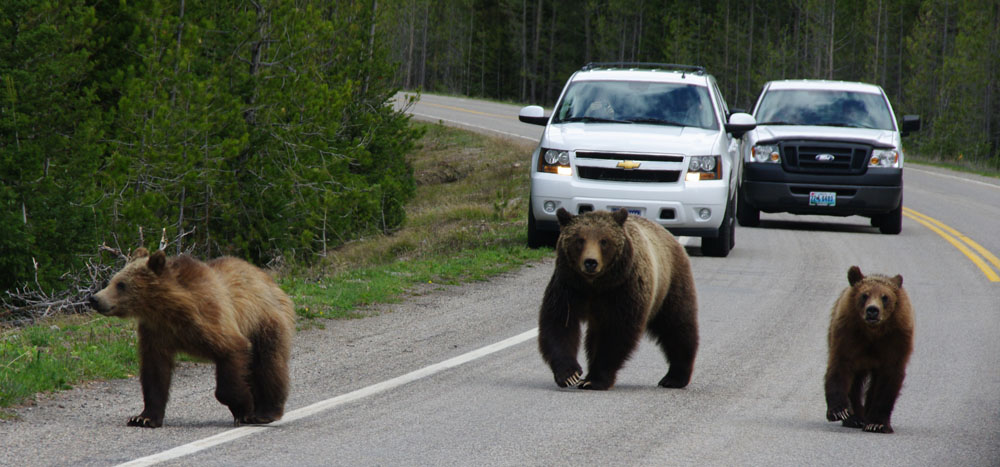
Imagine our surprise when this grizzly sow with two big cubs walked in front of us. This through-the-windshield shot shows the bears just after they stepped out of the woods.
The sow was extremely nervous. She was obviously surprised by the attention and confused about what she should do. She cringed whenever a car went by and looked like she was ready to defend her cubs.
Photography was fairly difficult because of the dark, overcast conditions. Notice the movement in her front paws as she walked toward me. This was caused by the 1/30 second shutter speed needed in the poor light.
Was it exciting to have a nervous, full grown grizzly walking toward me? You betcha!
Imagine our surprise when this grizzly sow with two big cubs walked in front of us. This through-the-windshield shot shows the bears just after they stepped out of the woods.
The sow was extremely nervous. She was obviously surprised by the attention and confused about what she should do. She cringed whenever a car went by and looked like she was ready to defend her cubs.
Photography was fairly difficult because of the dark, overcast conditions. Notice the movement in her front paws as she walked toward me. This was caused by the 1/30 second shutter speed needed in the poor light.
Was it exciting to have a nervous, full grown grizzly walking toward me? You betcha!
This cub certainly was aware of all the attention. The three bears were only there for about a minute before they walked back into the woods together.
Monday, March 26, 2012
Mountain Goats
Mountain goats are often seen in the Snake River Canyon near Alpine, Wyoming. It isn't unusual to see a few fairly close to the road in winter, but when we were there, they were a long way up the mountain.
Several members of our Sharp Shooters Camera Club have taken beautiful close-up photos of these interesting animals, but I wasn't so lucky. However, I was extremely fortunate to see a huge herd of over 75 goats grazing their way across the mountain. The snow had just about melted, so I suppose they were taking advantage of the bare ground to find food.
The herd was scattered over a wide area and was gone in about a half hour. This huge herd was probably a nursery group of nannies (females) and kids. The billies (males) usually form much smaller groups and keep to themselves. These photos show just a small part of the widely scattered herd. As the weather warms up they will head for higher elevations and won't be seen again until next winter.
Several members of our Sharp Shooters Camera Club have taken beautiful close-up photos of these interesting animals, but I wasn't so lucky. However, I was extremely fortunate to see a huge herd of over 75 goats grazing their way across the mountain. The snow had just about melted, so I suppose they were taking advantage of the bare ground to find food.
The herd was scattered over a wide area and was gone in about a half hour. This huge herd was probably a nursery group of nannies (females) and kids. The billies (males) usually form much smaller groups and keep to themselves. These photos show just a small part of the widely scattered herd. As the weather warms up they will head for higher elevations and won't be seen again until next winter.
Location:
Alpine, WY, USA
Saturday, September 24, 2011
Legend Rock Petroglyphs, Wyoming
The Legend Rock State Archaeological Site is 30 miles northwest of Thermopolis, Wyoming. Sometimes an on-site caretaker will let you in, but normally you need to get a key to unlock the gate. We got ours at the State bath house at the Thermopolis hot springs.
Petroglyphs are pictures pecked or scratched in rock. The Legend Rock site has an easy trail leading to several panels of pictures. One of my favorites was this Thunderbird in one of the first panels.

Petroglyphs at Legend Rock range from about 200 to 11,000 years old. These animals are among the oldest at the site, so they are not as distinct as newer ones.
Notice the two styles. The animals on the left are outlined and the ones on the right have their bodies filled in, which is known as "en toto".

Animal figures, like the ones above, are known as zoomorphs. Human-like figures, such as those to the right are anthropomorphs. These fantastic figures have horned headdresses and unrealistic bodies.

What is the meaning of something like this? Anthropomorphs are intertwined into one complicated figure with hands in strange places.
A panel under this figure was removed by vandals. This is a common problem at rock art sites so we were glad for the extra security at Legend Rock.
This amazing figure has extra feet, arms in the wrong place, and is missing much of his face. I think his strange personality jumps at you from the rock. Notice the writing in the upper right. When it gets this old, it can be referred to as "historic graffiti" and may even be considered to have historical value.
You can see more rock art at our web site: http://www.hisandhersphoto.com/Heritage/hhheritage.htm
Petroglyphs are pictures pecked or scratched in rock. The Legend Rock site has an easy trail leading to several panels of pictures. One of my favorites was this Thunderbird in one of the first panels.

Petroglyphs at Legend Rock range from about 200 to 11,000 years old. These animals are among the oldest at the site, so they are not as distinct as newer ones.
Notice the two styles. The animals on the left are outlined and the ones on the right have their bodies filled in, which is known as "en toto".

Animal figures, like the ones above, are known as zoomorphs. Human-like figures, such as those to the right are anthropomorphs. These fantastic figures have horned headdresses and unrealistic bodies.

What is the meaning of something like this? Anthropomorphs are intertwined into one complicated figure with hands in strange places.
A panel under this figure was removed by vandals. This is a common problem at rock art sites so we were glad for the extra security at Legend Rock.
This amazing figure has extra feet, arms in the wrong place, and is missing much of his face. I think his strange personality jumps at you from the rock. Notice the writing in the upper right. When it gets this old, it can be referred to as "historic graffiti" and may even be considered to have historical value.
You can see more rock art at our web site: http://www.hisandhersphoto.com/Heritage/hhheritage.htm
Monday, September 19, 2011
Bighorn Medicine Wheel, Wyoming
The Bighorn Medicine Wheel is a geoglyph in northern Wyoming. That is, it is a pattern laid out in stones on the ground. This Medicine Wheel has been used for Native American rituals since its construction anywhere from 500 to 1500 years ago. Access to the Medicine Wheel is limited to a few summer months because of its remote location and 9642' elevation.
The trail to the Medicine Wheel is about three miles round trip, and nearly every step is uphill or downhill. At this high elevation it can be a difficult walk for some people, but the high mountain scenery is spectacular. People who have difficulty walking can drive to the site if they can figure out how to get past the log gate. I walked, but had to leave Linda back at the parking lot.
The Medicine Wheel is 80' in diameter and has 28 spokes. The four outer cairns align with the rising and setting sun during the summer solstice. Perhaps the spokes represent the 28 days of the lunar month. The Medicine Wheel appears to be part of an enormous network of regional prehistoric sites dating back 7000 years! Note that this photo was altered in Photoshop to remove a rest room and two cars from behind the back fence.
Prayer offerings are still being left on the rope fence all the way around the Medicine Wheel. After I hiked back to the parking lot I managed to open the gate and drive Linda to the site so that she was able to see it. And, I got to see it twice.
Montana State University picked up two of these photos and used them in their magazine, "Confluence". You can see the article and photos on page 11 here: http://issuu.com/montanastateuniversity/docs/confluence2011
The trail to the Medicine Wheel is about three miles round trip, and nearly every step is uphill or downhill. At this high elevation it can be a difficult walk for some people, but the high mountain scenery is spectacular. People who have difficulty walking can drive to the site if they can figure out how to get past the log gate. I walked, but had to leave Linda back at the parking lot.
The Medicine Wheel is 80' in diameter and has 28 spokes. The four outer cairns align with the rising and setting sun during the summer solstice. Perhaps the spokes represent the 28 days of the lunar month. The Medicine Wheel appears to be part of an enormous network of regional prehistoric sites dating back 7000 years! Note that this photo was altered in Photoshop to remove a rest room and two cars from behind the back fence.
Prayer offerings are still being left on the rope fence all the way around the Medicine Wheel. After I hiked back to the parking lot I managed to open the gate and drive Linda to the site so that she was able to see it. And, I got to see it twice.
Montana State University picked up two of these photos and used them in their magazine, "Confluence". You can see the article and photos on page 11 here: http://issuu.com/montanastateuniversity/docs/confluence2011
Tuesday, September 13, 2011
Gebo, Wyoming ghost town
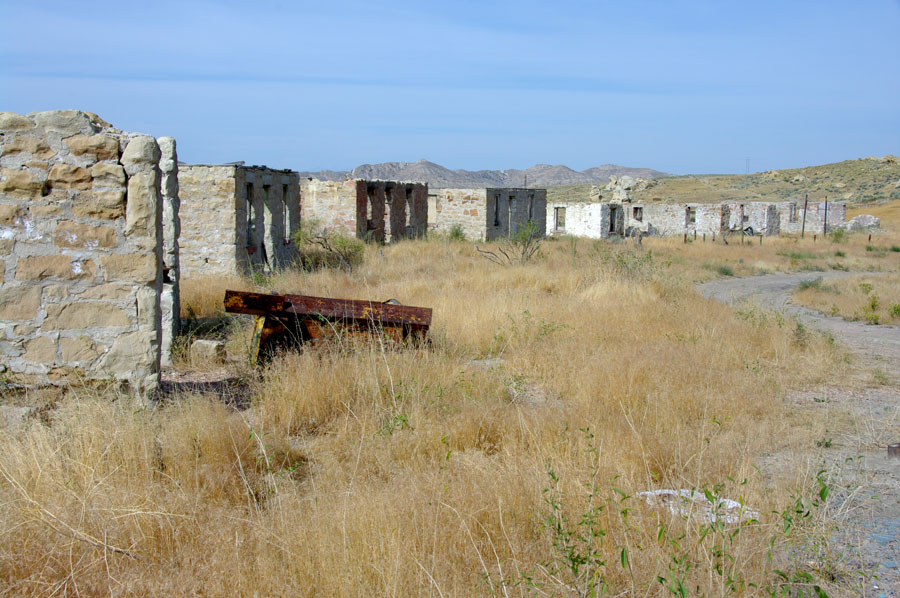
Gebo, Wyoming is an isolated ghost town near Worland. It was a coal mining town from 1906 until 1938.
There are seven ruined stone buildings curving along the top of a ridge. They might have been nice at one time since they still have remnants of concrete sidewalks, gates, brick windowsills, and other comforts.
The town had 1200 residents in 1929 and buildings were scattered over the desolate countryside. BLM leveled most of the town in 1971. So, why did these buildings survive?
Maybe these stone ruins were on private land so BLM had to leave them standing.
Vandalism and the passage of years have not been kind to Gebo. The town is used for target practice now.
There are seven ruined stone buildings curving along the top of a ridge. They might have been nice at one time since they still have remnants of concrete sidewalks, gates, brick windowsills, and other comforts.
The town had 1200 residents in 1929 and buildings were scattered over the desolate countryside. BLM leveled most of the town in 1971. So, why did these buildings survive?
Maybe these stone ruins were on private land so BLM had to leave them standing.
Vandalism and the passage of years have not been kind to Gebo. The town is used for target practice now.
Labels:
Gebo,
ghost town,
Wyoming
Location:
Gebo, WY 82443, USA
Thursday, May 26, 2011
Yellowstone in Storm Light
This is the year for nearly continuous storms in our part of the country. When we visit Yellowstone, we prefer to take photos in great light, but we certainly aren't going to put the cameras away if the weather doesn't cooperate. So, what can be done to get decent photos in storm light?
One option is to use the storm clouds as part of the composition. Here at the Upper Terrace at Mammoth Hot Springs I think the storm complements the steam.

Images with a more graphic composition may work better if the sky is excluded. This tree at the Upper Terrace seems more dramatic with the subdued folds of black hills in the background.
Lower Falls and the Grand Canyon of the Yellowstone are normally shown with gorgeous yellow color in the canyon walls. But, we were there in light snow and bald skies which erased much of the dramatic color. Without color, one approach is to try to capture the atmosperic conditions while retaining the sweep of the canyon walls and the falls. To do this, one option is to minimize the uninteresting sky, showing just enough to retain the shape of the horizon. That way, the light snow softens the mountain and trees in the background so the viewer can understand the stormy conditions.
One option is to use the storm clouds as part of the composition. Here at the Upper Terrace at Mammoth Hot Springs I think the storm complements the steam.

Images with a more graphic composition may work better if the sky is excluded. This tree at the Upper Terrace seems more dramatic with the subdued folds of black hills in the background.
Lower Falls and the Grand Canyon of the Yellowstone are normally shown with gorgeous yellow color in the canyon walls. But, we were there in light snow and bald skies which erased much of the dramatic color. Without color, one approach is to try to capture the atmosperic conditions while retaining the sweep of the canyon walls and the falls. To do this, one option is to minimize the uninteresting sky, showing just enough to retain the shape of the horizon. That way, the light snow softens the mountain and trees in the background so the viewer can understand the stormy conditions.
Monday, May 23, 2011
Bison Baby
Spring is the time to see baby animals in Yellowstone, so Linda and I packed the long lenses and headed north. The first day we saw just one baby bison from a long distance. The second morning we saw two more, also from far away. Had the long, hard winter somehow delayed bison births? We had a great time exploring the Park despite stormy weather, but resigned ourselves to the probability that we would not see any babies up close. Then, just before we were ready to leave, we got lucky!
We spotted a brand new bison near the road in a small herd near Midway Geyser Basin and tried to get photos in the heavy overcast. These calfs have a distinctive orange color and are on their feet and active soon after birth. We watched this one try to figure out how to get food for the first time.
The calf nursed from at least two cooperative bison. Had one female, other than the mother, lost a baby so she was still able to feed a calf? This little one should fatten up fast with all the attention it is getting, but it was not welcome everywhere. It got a swift kick when it tried to nurse from yet another bison. We wish we could be there when the baby elk show up in another week or two.
We spotted a brand new bison near the road in a small herd near Midway Geyser Basin and tried to get photos in the heavy overcast. These calfs have a distinctive orange color and are on their feet and active soon after birth. We watched this one try to figure out how to get food for the first time.
The calf nursed from at least two cooperative bison. Had one female, other than the mother, lost a baby so she was still able to feed a calf? This little one should fatten up fast with all the attention it is getting, but it was not welcome everywhere. It got a swift kick when it tried to nurse from yet another bison. We wish we could be there when the baby elk show up in another week or two.
Monday, April 4, 2011
Spring Transition
A change is coming to the Idaho high country. Spring, also known as mud season, is starting in the Bear Lake Valley and the surrounding high country. We have had a lot of snow and when it melts we put up with mud until the run-off subsides.

Just a few days ago the hills east of Montpelier still had snow, and I photographed this small herd of elk from our deck. Now most of the snow is gone and the elk have left for the back country.
A young moose in neighboring Star Valley, Wyoming was content to rest in willows near the Salt River and let us take pictures. Once in a while she nibbled a twig as we watched.
As the snow melts and bare ground appears, migrating sandhill cranes and Canada Geese look for food in fields where cattle are being fed. These were seen between Montpelier and Ovid, Idaho.
Photographers, grab a long lens and come to the Bear Lake Valley to look for wildlife!
Location:
502 Boise St, Montpelier, ID 83254, USA
Saturday, January 29, 2011
Chariot race photos
Chariot races in Wyoming? Every January chariot races are held in Afton, Wyoming on Saturday afternoons. The races are a straight line sprint using two horses pulling a home-made chariot down a dirt track plowed out of the snow. We always enjoy our 50 mile trips to Afton and have a regular routine with stops at Rocky Mountain Seafood, Alan's Photo Store, and Dog Eared Books.
Notice the horse on the right with all four feet off the ground!
Each race takes about 23 seconds. A fairly slow shutter speed blurs the background and emphasizes the speed.
Location:
Afton, WY 83110, USA
Subscribe to:
Posts (Atom)