Showing posts with label ghost town. Show all posts

Sunday, December 2, 2018

Comet, Montana Ghost Town


The last ghost town we visited on our summer camping trip, Comet, Montana, was one of my favorites.  Comet’s first mining claim was in 1869 by John W. Russell and the town was started in 1876.  The area was called the High Ore Mining District.

A row of old cabins greets visitors as they enter town.  There were about 300 people here until the mines started to play out and Comet was described as a ghost town in 1913.

In 1926 the Basin Montana Tunnel Company built a 200 ton concentrator which became the second largest mining venture in Montana.  Local mines went on to produce over 20 million dollars of silver, gold, lead, zinc, and copper.  The mill shown here with the bunkhouse was closed in 1941 and the equipment salvaged.

There are lots of wonderful old buildings like this boarding house.  Miners stayed here for 75 cents room and board.

There wasn’t enough left of this truck to identify it, but my guess is it was used to haul ore, based on the 16 leaf springs.  Comet is privately owned and there is one occupied house, so private property must be respected.  However, buildings can be viewed from the road.


There are still a few houses scattered across the hillside.  The town once had a school with 20 pupils, but they were outnumbered by the 22 saloons.


We had some pretty good clouds that day, and some of them worked well with the collapsing buildings.


There is usually an opportunity for interesting detail photos in places like Comet.

Comet was built on mining, so I will end with a photo of a mine headframe with a trestle connected to an ore bin. There is still a winch in a small building with a cable leading to the shaft on top of the hill.

Remember, these photos are copyrighted and should not be used for any purpose without permission, and usually a small payment, unless used for charitable or academic purposes.

Thursday, October 25, 2018

Granite, Montana Ghost Town


I knew that Bruce Gregory and Stephen Johnson would enjoy Granite, Montana based on my visit there in 2005 with my wife and our neighbors.  So, Granite was one of our destinations on our summer camping trip.


There was a silver bonanza in the 1880’s on Granite Mountain, and soon the mountaintop was packed with buildings.  The centerpiece was the magnificent Miner’s Union Hall, now a big brick ruin.  The elegant building once had a dance floor / auditorium, lodge room, office, library, and more.

Mae Werning’s house is down the street.  She was the watchman and last resident of Granite and died in 1969 at age 75.  Most houses now are just piles of lumber or overgrown rock foundations.


Granite Mills A and B together ran 80 stamps until the 1890’s.  In the 1950’s the buildings were intentionally burned for safety reasons, leaving these gigantic foundations.


Just down the road along the face of the mountain ruined structures of the Ruby Mine are on the verge of collapse.
Granite has some of the biggest ghost town structures we have found on our camping trips.  It is amazing to think about what it was like to live and work here more than a century ago.
I hope you enjoy these photos, but please be aware that they are copyrighted and can not be used for any purpose without permission and reasonable compensation.


Tuesday, October 2, 2018

Elkhorn, Montana Ghost Town


I am still trying to catch up on reviewing photos from our annual camping trip to Montana.  So, here are photos of Elkhorn, Montana, one of five ghost towns we visited in July.

 This silver mining town was established in 1872 and had a peak population of about 2500.  Now the population is 10, but I’ll bet most of them are part time residents.

The big attraction for ghost town hunters is Gillian Hall (left) and the Fraternity Hall (right).  These buildings are now preserved as Montana’s smallest state park.

The National Register of Historic Places states that the Fraternity Hall (built in 1893) is perhaps the most photographed ghost town building in the United States and lists it as number 1 of 12 western structures that should be saved.  This room was used for dances, meetings, and theatrical shows.

Elkhorn is a mix of abandoned and restored buildings.


The beautiful cemetery is on a quiet isolated hillside.  A large number of children were buried there after a diphtheria epidemic in 1888 - 1889.


Mining relics and ruins are scattered around, but most are in areas posted “no trespassing”.  The mines opened and closed several times and were finally closed for good in 1937 after producing about $14 million of silver.  Except for the two Halls, most of the town is private property but can be photographed from the road.


Please be aware that these photos are copyrighted.  If you would like to use them for any reason, please contact me.  My fees are very reasonable, and often free for charitable purposes.

Sunday, November 19, 2017

Catalina Federal Honor Camp

Over the years I have visited four of the World War II Japanese Internment camps and learned about the shameful imprisonment of people just because they were of Japanese descent.  The four camps I have been to are Manzanar, California; Heart Mountain, Wyoming; Minidoka, Idaho; and Topaz, Utah.  I previously posted photos of Minidoka and Topaz on this blog.  Here is the story of another site where people from those camps were sent if they were “troublemakers”.

I just returned from visiting my son and his wife, Brian and Laura, in Tucson, Arizona and while there visited the remnants of a prison camp.  The Catalina Federal Honor Camp housed over 8000 prisoners between 1933 and the early 1950’s.  They were there to build the Catalina Highway up Mt. Lemmon, and among the prisoners were 46 Japanese draft resisters, conscientious objectors, and Gordon Hirabayashi, who defied the government relocation and turned himself in to the FBI.  He was convicted of a curfew violation and sentenced to 90 days in prison after fighting the charge all the way to the Supreme Court.

The prison was an honor camp without walls.  Painted white stones and strong warnings were all that kept the prisoners there.  Even so, the Japanese prisoners were transferred from internment camps in leg irons by armed guards.  Mr. Hirabayashi was the exception.  He hitchhiked to the camp.

The draft resisters were pardoned in 1947, and Gordon Hirabayashi’s conviction was overturned in 1987 when it was discovered that evidence in his favor had been withheld.  He was awarded the Presidential Medal of Freedom posthumously in 2012.  After the war, the camp was used as a labor camp for juvenile offenders, then a youth rehabilitation center.  After it closed in 1973 the buildings were destroyed, and the site turned into a campground.  It is now the Gordon Hirabayashi Recreation Site in honor of its most famous prisoner. 


I am grateful to an old friend, Merry Lewis, for taking Linda and me to this historic site.  In a sense, this is a ghost town with nothing but walls and concrete slabs left where there used to be barracks, a mess hall, employee cottages, a baseball field, and many other buildings.

Left, Linda
Right, Merry

 Photos are copyrighted and must not be used without permission.

Friday, October 27, 2017

Monarch Mine, Nevada

After leaving Sprucemont, Nevada (see the previous post), we continued up Spruce Mountain about two more miles.  The road got much rougher, although it was not nearly as difficult as we expected.  I did use four-wheel drive, and in one or two places low range, and was glad I recently added skid plates to my truck.

Our first view of the mine area included a few houses along a side road.  The area is very steep, with houses on different levels of the hillside.

Most of the buildings are frame houses, but there is one cabin made from massive logs that probably dates back to the earliest days of the mine, around 1899.

This is a true ghost town.  Many buildings are totally collapsed, and those that are still standing have a lot of damage.  Some look like they were nice at one time, but now the wallpaper is peeling and the ceilings coming down.  But, their positions high on the mountains had great views from the windows.


There is a huge crumbling ore bin right in the middle of the residences, and a mine shaft nearby, so miners didn’t have to go far to work.  The gigantic timbers were held together with massive nuts, bolts, and square washers.  Now many are gone, and others are beautifully rusty.

The Monarch Mine was a big producer of lead during World War I.  According to the USGS website, 

"About $200,000 worth up to 1902; 21,000 tons ore worth $475,000 from 1919 to 1921; more production through 1952. Total production was over $1,000,000 worth, including some zinc and copper."

This photo gives some idea of how steep the mountain is, and how houses were built on plots leveled out of the hillside.  We enjoyed exploring the townsite, but didn’t stay long because snow flurries started, and we were a long way from pavement.  The Spruce Mountain mining area was well worth the visit.

I hope you enjoy the photos, but please respect the copyrights and do not use them for any purpose without permission.

Tuesday, October 24, 2017

Sprucemont, Nevada

We were on our annual fall camping trip with plans to explore ghost towns in Montana.  Then the weather went bad and we decided to migrate south.  We spent a day in Wells, Nevada and searched for ghost towns in the Spruce Mountain mining district.

We were looking for Sprucemont, about 10 miles from the nearest paved road, and got into a maze of dirt roads on Spruce Mountain.  When the roads got worse we decided to turn around and look for another route, and I spotted the remains of this log cabin high on a nearby ridge.  It is an unusual double cabin, which makes me think it could have been part of a string of businesses along the town’s main street.  The other side of the cabin has collapsed, and most of the dirt roof is gone.

We looked uphill and saw other structures.  These were much newer frame buildings, which had all been vandalized, and a few had totally collapsed.  The weather was heavily overcast with a storm moving in, so the light wasn’t very good, but then the clouds broke, and I got a decent photo of this old house.

Sprucemont began about 1870 when several mines were started on Spruce Mountain.  By 1887 there were five saloons here, but just a year later, mines were closing and Sprucemont was nearly deserted.  In 1899 the Monarch Mining Company was started, and Sprucemont came to life, but was again nearly deserted by 1913.  In the 1930’s a third period of mining started, and continued through about 1952.  By 1961 the district had ceased all production.  This helps explain the different building styles we see at Sprucemont.  The big log cabin likely dates from the first or second era, and the frame buildings from the third.

The people who lived in Sprucemont had a million-dollar view of the East Humboldt range. The cloud shadows crossing the valley seemed to emphasize the immense space of the valley at the base of Spruce Mountain.

From here we continued up the mountain to find the Monarch Mine.  I will try to post that adventure in a few days.

Please remember, these photos are copyrighted.  I will allow them to be used for charitable purposes, but charge reasonable fees for personal use.

Monday, October 24, 2016

Humboldt City, Nevada

About 500 people lived here once, but Humboldt City has been a ghost town since the post office was removed in 1869.  Silver was discovered here in 1860, and the city was built here to support several mines.  But, it didn’t last long.
A dirt road runs from the valley through the center of town.
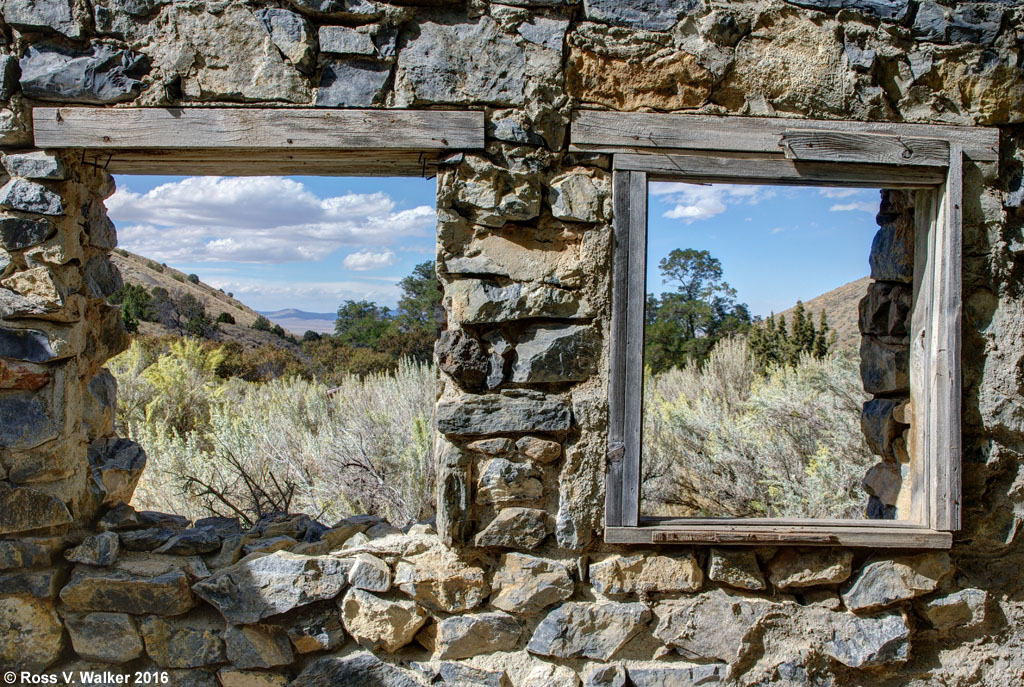
Humboldt City is located along a creek that runs through a canyon high on a mountain in the Humboldt Range of Nevada.  There were 200 buildings here, and now you can still find many rock ruins scattered through the underbrush and on the hillsides.
Some of them, like this one with the double windows, have signs that people tried to move in here long after the city was abandoned.  We found a cinder block fireplace added to this old rock wall.
This cabin also has some modern materials like rusty window screens.  It was hard to get to because it was built in a deep gully next to the creek.  I don’t understand why it wasn’t washed away years ago.
There were two hotels here; the Coulter House and the Iowa House.  I’m guessing that this ruin was one of them because of the large front room and a smaller room in back that could have been a kitchen.
The view from the hotel looked up the canyon toward the mountains where the mines were located.  It looks like it has been a long time since the last “No Vacancy” sign went up.

Humboldt City is just a couple of miles from busy Highway 80, near Mill City, Nevada, but being there is like being in a different world.

Remember, all my photos are copyrighted.  Please do not use them for any purpose without permission.

Friday, October 30, 2015

Knight Mill, Silver City, Utah

People seem to be attracted to large building ruins.  The Parthenon in Greece, Coliseum in Italy, Machu Picchu in Peru, and Mayan ruins in Central America are all big tourist attractions.  We have our massive ruins here in the American west too, but they are largely ignored except by ghost town hunters.
The Knight Mill ruins are a good example.  This massive concrete ruin is on the edge of Silver City, Utah, a ghost town that has nearly completely disappeared.  The smelter was built here in 1907 and it shut down in 1915.
Jesse Knight found several mines in the Eureka, Utah area, including the Humbug and the Iron Blossom lode, so he built this smelter and a railroad to process the ore.  The mill was closed and dismantled when it became more economical to ship ore to a more modern mill.
There are extensive ruins of solution tanks just outside the more massive ruins of the main mill building.  These tanks could be a source of dangerous contamination and should be avoided.
So much of the building has been destroyed that there aren’t many small details to photograph, but there is still some interesting rust on site.  It looks like iron beams were cut off and their stubs left to rust into fantastic shapes.  Is this a nightmarish bird or a bat?
Ore was crushed and mixed with mercury, resulting in an amalgam that had to be heated to separate the valuable metals.  I think this was a kiln used to cook amalgam to separate mercury from gold and silver.  Of course, the kilns could also be a source of contamination that should be avoided.
I like this desert arch, which is probably all that is left of another kiln.  It seems so out of place out there by itself.

While I can’t say that ruins like this are beautiful, like the classical ruins mentioned above, they are interesting and awe inspiring.  They are a big part of our western history, which is disappearing fast, and they deserve to be documented.

All photos are copyrighted and must not be used for any purpose without my permission.

Wednesday, June 3, 2015

Cerro Gordo Revisited

I posted an article on Cerro Gordo on June 4, 2012, so please check it out to learn more about this remarkable ghost town    http://rosswalkerphotos.blogspot.com/2012/06/cerro-gordo-california.html
 
We returned to Cerro Gordo  on April 29 this year, so this is a supplement of sorts.  Caretaker Jim has been replaced by Cat and Matt, but there haven’t been many other changes.  Here they are with my camping buddies, Bruce and Steve, in front of the beautiful American Hotel, which is the oldest hotel still standing in California east of the Sierras.
Cerro Gordo’s old mining town buildings look great in black and white.  The assayer’s building is on the left, and the cribs from Lola’s Palace of Pleasure are on the right.  Cerro Gordo had numerous businesses, including a red light district.
There are artifacts from the mining days scattered everywhere, like these ore bins that used to ride the tram from the mines to the smelter here in town.
The streetlight outside the general store seems to be out of order, and the store is a museum now.
Other odd objects include a worn saddle pommel and a rusty lock.

This view shows some of the water storage tanks that were once needed for a population of 4500. 

When I first started exploring ghost towns, Cerro Gordo was famous, but off-limits.  People could take pictures from the road but had to stay away from the private property.  Fortunately, the Friends of Cerro Gordo now help preserve the town and provide caretakers, so we were able to visit this great old town.

Please note that my photos are copyrighted and cannot be used without my permission.