Showing posts with label National Park. Show all posts

Friday, May 31, 2019

Painted Desert, Arizona


My most recent post showed petrified wood at Petrified Forest National Park in Arizona.  The other big attraction at the park is often called the “painted desert”.

The painted desert stretches across much of northern Arizona, so this national park covers just a small portion, but it is easily accessible here.  The brown debris near the center of this photo is probably fragments of petrified logs.


The layers of color were created over millions of years of change in the earth’s surface.  Earthquakes, volcanic ash, and flooding deposited layer after layer of different minerals, and erosion exposed them for us to see.


These hills are known as “the tepees”.


I only had a few hours to explore the park, but I noticed that the best petrified logs are in the south, and the best views of the painted desert are in the north.


The variations of color are just amazing, and this photo gives some idea of the vast uninhabited space around the Park.

There are other attractions in the park including petroglyphs, pueblo ruins, and a Route 66 monument.  It is well worth the trip.

Thanks for looking, but remember that these are copyrighted photos that can not be used without permission, and in most cases a reasonable fee.

Friday, May 17, 2019

Petrified Forest

I drove to Tucson last month to visit my son Brian and his wife Laura.  On the way back I took an extra day to explore Petrified Forest National Park near Holbrook, Arizona.  There are two main attractions there, the painted desert and the petrified forest.  Here is the story of the Petrified Forest.


Some people think they are going to see a standing forest here, but the trees turned to stone after they fell and were washed downstream and buried during the late Triassic period around 200 million years ago.


As millions of years passed, the buried logs absorbed water and silica from volcanic ash which crystallized into quartz which often kept some of the logs’ details.


Spectacular colors were added by various minerals.  The colors in this photo have not been altered.


The crystallized logs were harder than the soil where they were buried.  Over time, erosion removed the surrounding dirt and the logs surfaced.  Sometimes the logs helped reduce the erosion under them, leaving them balanced on a narrow ridge.


Many of the huge logs look like they have been sectioned with a chainsaw.  This happened when they were still buried and earth movement caused forces that snapped the crystallized logs like breaking glass rods.

The petrified logs are mostly in the southern part of the park, but if you go be sure to see the painted desert in the north as well.

I hope you enjoy the photos, but remember they are copyrighted.  Please don’t use them without permission.

Monday, July 4, 2016

Minidoka Pilgrimage

I’m on my 45th camping trip, in our 35th year with Bruce Gregory and Stephen Johnson, and we traveled to the Minidoka Japanese internment camp in Idaho, also called Camp Hunt.  We are all interested in western history, and since I had been there a few years ago I knew they would enjoy it.  It turned out to be an amazing experience.


When we arrived we found out that there were two special events in progress.  Former internees and their descendants were there by the busloads for an annual pilgrimage, and a new baseball field was being dedicated.  There were about 250 people present to remember the past, discuss the possibilities of this injustice happening again to other ethnic groups, and to look to the future of the camp.  Many came from the Seattle area, where a large number of internees originated in World War II.


Baseball was important to many of the 9000 people who were forced to live there, and the restoration of one of the fourteen ball fields was completed as a field-in-a-day project on May 28th and dedicated during our visit on June 26th.


 Several people there wore Camp Hunt baseball shirts.


Minidoka is run by the National Park Service, and at one time there was very little left of the site, but now parts of it are being restored.  There are still a few concrete slabs from original structures, and now buildings that were removed from the camp when it was closed are being located and moved back.  A guard tower replica has been constructed and interpretive signs have been put in place.  So, the National Park Service and Friends of Minidoka are working together to build a site that will help people understand the injustice that occurred here.

For now, artifacts from Minidoka are on display at Hagerman Fossil Beds National Monument visitor’s center, which is 38 miles away.  I hope that someday soon an on-site visitor’s center will be completed.


A highlight of the visit for me was the placing of origami peace cranes on a barbed wire rack.  People wrote their thoughts and dedications on the cranes before tying them to the rack.


The day was a moving experience for everyone there, and I feel that we stumbled on an important piece of Idaho history.


See my blog post about Topaz for a brief explanation of internment camps.

Remember to ask permission before using my copyrighted photos for any purpose.

Wednesday, February 12, 2014

Artist Point, Yellowstone

The Sharp Shooters Camera Club had a field trip on February 8, 2014 to Yellowstone National Park.  We reserved a snowcoach and left from West Yellowstone, Montana on a snowy day.  The snowcoach took us along the Madison River and across the park to the Canyon area where one of the stops was at Artist Point.  The driver was worried that we wouldn't be able to see much because of the storm, but the snow eased up when we arrived at the Canyon.


Artist Point was thought to be the location where Thomas Moran created a famous painting in 1872.  It was named by park photographer F. Jay Haynes about 1883 and the name stuck, even though the painting was actually done at Moran Point.

Our view was straight down the magnificent Grand Canyon of the Yellowstone toward Lower Falls, which were about a mile away.  The wind was blowing hard, and photography was difficult with snow blowing toward the camera.

Notice the yellow color of some of the cliffs that gave the park its name.

As we zoom in closer, the Yellowstone River and Lower Falls become easier to see.

Finally, the third photo shows a closeup view of the 308 foot falls, which were partially frozen.  An inverted V of water along the left edge drops down to a huge mound of snow and ice at the base of the falls.


The trail back to our snowcoach was a snow-covered uphill walk along the canyon wall.  It was interesting to look down on the rocks and trees in the deep snow.  This tree was the only one to survive the steep cliff and snowdrifts in one area.
If you don't mind a little cold and snow, a snowcoach tour is a great way to see Yellowstone.

Thursday, December 26, 2013

Arches National Park, Utah

This is a flashback to a trip Linda and I took to southeastern Utah last October.  We were exploring the red rock country from the Green River area to Monument Valley in northern Arizona.  One evening we drove into Arches National Park to photograph the late light.  Arches is located near Moab, which is the perfect place to stay to explore several state and national parks.
It is nearly impossible to find unique photos in Arches National Park.  The place is so beautiful that I can't imagine how many photos have been taken there.  After entering the park, there is a steep hill to ascend, followed by this magnificent sandstone ridge called Park Avenue.  As the sun descended in the west, shadows from another ridge were outlined on the huge formations of Park Avenue.
Continuing on, we soon came to Balanced Rock, another site that has been photographed thousands of times.  As the sun continued to drop in the west, the rock took on a bright glow.  Pretty, but what could be done to make it different from the average tourist photo?  I decided to fill the sky with this rugged old tree as a companion to the beautiful red rock.
We really weren't very far into the park when we turned down a side road to the Windows area.  The scene was changing fast as the sun nearly touched the horizon.  When I got to North Window there was a crowd there watching the moonrise through the arch.  Just a couple of years earlier, I had the good fortune to photograph a sunset here when I had the view to myself.  Anyway, I kind of like having people in the picture to add human interest and scale.  By now, the very low sun had turned the reddish brown rock a glowing orange-red.
Just a few minutes later the glow was gone.  I turned and looked toward the west in time to see the sun disappear, giving me a quick silhouette of Turret Arch to photograph.  Magnificent!

I barely scratched the surface of all there is to see in Arches National Park.  The road goes on for miles past several more arches, and there are trails to many more.  I've learned from experience that this is one place where early or late light is the only way to go for most images.

Tuesday, May 8, 2012

Surrounded By Bison

The same day that we encountered the grizzlies (see previous post) we were surrounded by a herd of about twenty bison in Grand Teton National Park.  We first saw them grazing in a beautiful aspen grove at Mormon Row.
Some tourists were standing nearby, and one big male was giving them the evil eye.  I put my camera on the "continuous" setting in case I got an opportunity to photograph action shots as the bison charged the tourists, but no such luck.


The tourists eventually left, so I drove closer and parked so that Linda would have a clear view out the passenger window.


The bison were much more comfortable around the car than around the tourists, and they walked right up to us.  It turned out that I had parked next to rain puddles, and that must have been why the bison were waiting for the tourists to leave.


The huge animals all drank from the puddles as we took photos from just a few feet away.
I had a tough time getting a clear view because I had to shoot past Linda.  But it worked out OK because my restricted viewpoint encouraged close-ups of the bison as they drank.  The huge animals didn't seem threatening at all, as long as we stayed in the car, but I did wonder what would happen if they decided we didn't belong there.

As they finished drinking, the herd wandered around the car to a field, surrounding us for awhile.  I enjoyed watching a calf watch me as a big one passed behind the car.  What a day of wildlife photography!


Monday, May 7, 2012

Grizzly Encounter

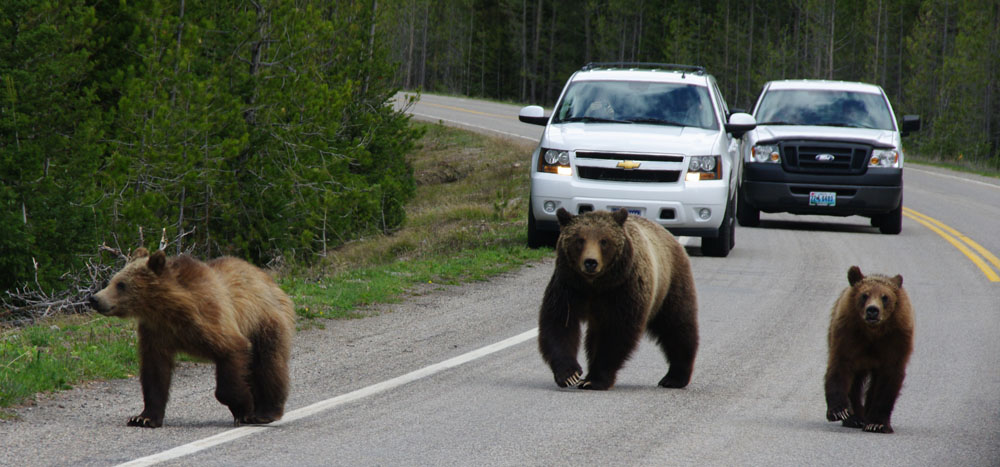
Linda and I visited Grand Teton National Park for a couple of days last week and were sure we wouldn't get any decent photos because of the terrible weather.  Heavy overcast, rain, snow, wind... we had it all.  We didn't see the beautiful views we wanted, but were thrilled by the abundant wildlife.
Imagine our surprise when this grizzly sow with two big cubs walked in front of us.  This through-the-windshield shot shows the bears just after they stepped out of the woods.


The sow was extremely nervous.  She was obviously surprised by the attention and confused about what she should do.  She cringed whenever a car went by and looked like she was ready to defend her cubs.


Photography was fairly difficult because of the dark, overcast conditions.  Notice the movement in her front paws as she walked toward me.  This was caused by the 1/30 second shutter speed needed in the poor light.


Was it exciting to have a nervous, full grown grizzly walking toward me?  You betcha!


This cub certainly was aware of all the attention.  The three bears were only there for about a minute before they walked back into the woods together.