Showing posts with label hills. Show all posts

Friday, May 31, 2019

Painted Desert, Arizona


My most recent post showed petrified wood at Petrified Forest National Park in Arizona.  The other big attraction at the park is often called the “painted desert”.

The painted desert stretches across much of northern Arizona, so this national park covers just a small portion, but it is easily accessible here.  The brown debris near the center of this photo is probably fragments of petrified logs.


The layers of color were created over millions of years of change in the earth’s surface.  Earthquakes, volcanic ash, and flooding deposited layer after layer of different minerals, and erosion exposed them for us to see.


These hills are known as “the tepees”.


I only had a few hours to explore the park, but I noticed that the best petrified logs are in the south, and the best views of the painted desert are in the north.


The variations of color are just amazing, and this photo gives some idea of the vast uninhabited space around the Park.

There are other attractions in the park including petroglyphs, pueblo ruins, and a Route 66 monument.  It is well worth the trip.

Thanks for looking, but remember that these are copyrighted photos that can not be used without permission, and in most cases a reasonable fee.

Monday, June 4, 2018

Millions of Wildflowers


There are foothills in the Bear Lake Valley that always have a lot of spring wildflowers, but this year is exceptional.  Linda and I were invited to a wedding at a beautiful house on 300 acres high in the foothills and were amazed at the view and the mass of wildflowers.  The owners graciously invited us to return for photos, and we went back twice.


Most of the flowers are arrowleaf balsamroot, a showy, large flower.  Many acres of the hillside are a mass of yellow because of these flowers.


This area had several varieties of lupine mixed with the arrowleaf balsamroot.


Here are two of the many variations of lupine.


Patches of blue camas were a surprise because they are usually found in wetlands.  When I went back a couple of days later many of them were drying out.


We continued higher up the hill on our second visit.  The mass of yellow flowers disappeared and were replaced by scattered Indian paintbrush.  It is remarkable how the elevation change made such a difference.  It has been a beautiful spring.

Please respect my copyright and do not use these photos for any purpose without permission.  Thanks.

Friday, July 14, 2017

Painted Hills, Oregon

John Day Fossil Beds National Monument has three separate units.  One of these, the Painted Hills, near Mitchell, Oregon, is famous for its amazing hills striped with color.  It was the highlight of my 47 th camping trip in 36 years with Bruce Gregory and Stephen Johnson.
During the day the colors can appear fairly muted, but as the sun gets low the stripes become brighter, as in this photo from the overlook trail.


The wonderful stripes and contours are perfect for landscape abstracts with a long lens.  These two photos from the overlook trail show how the colors can change with the time of day.  The colors often become golden just before sunset.


Another beautiful location is the perfectly formed Red Hill, where we also found prairie clover.


The soil here is very delicate and would be damaged by walking on it, so most areas are fenced off.  In the Painted Cove area a boardwalk allows visitors to see the textures and shapes close up.

And finally, here is a five shot panorama taken from the overlook trail just as afternoon shadows start to touch the hills.

I hope you enjoy these photos, but please remember that they are copyrighted and must not be used without permission, and usually payment of a small fee.

Saturday, June 11, 2016

Palouse Contours, Washington

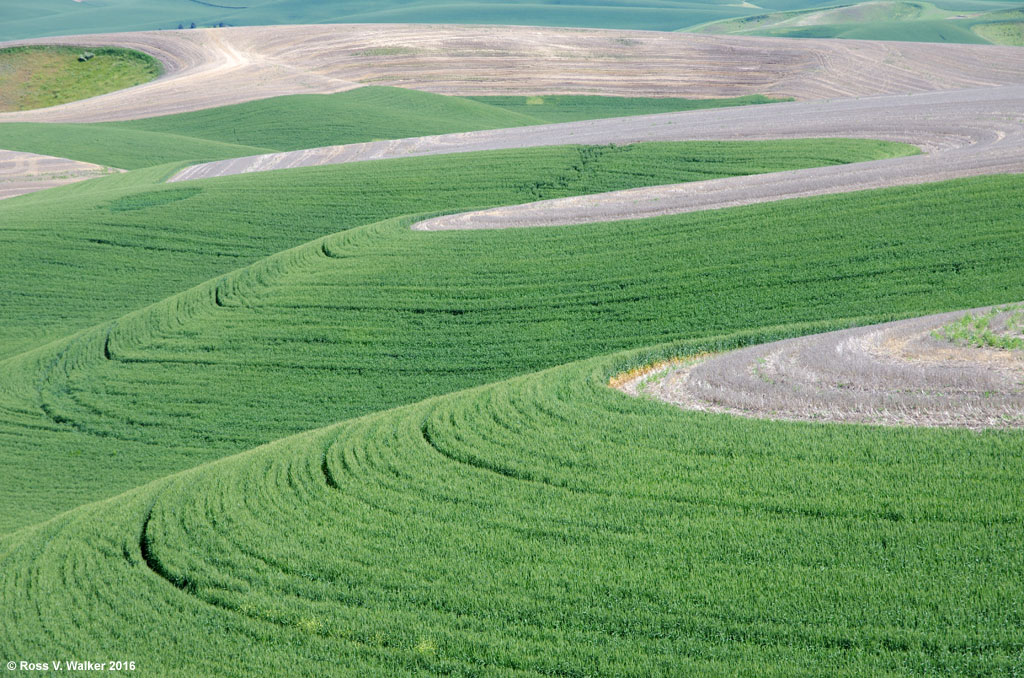
The Palouse region of Washington is a remarkably beautiful area of rolling hills and well-kept farms.  Photographers enjoy patterns of green fields cultivated along the curves of these hills.  This is my second post from my recent trip with Linda.


We explored several areas looking for patterns in the cultivated hills.  These two photos were taken near Almota on the edge of the Snake River Canyon.  They are pretty good examples of how many of the fields are farmed wherever the hills aren’t too steep for machinery.  In fact, in many parts of the Palouse, special hillside combines are used.


These two photos were taken along back roads near Steptoe.  You can see what a wonderful effect cloud shadows have on the rolling hills.  Back roads are the best way to explore the Palouse because it is easy to stop anywhere without worrying about traffic.


The last two were taken very close together near the small town of St  John.  Very often two crops are planted on the same hill, for example, rows of garbanzo beans over wheat.  This often results in beautiful stripes or contrasting patterns.  This early in the year we found many fields with unplanted layers over lower bands of green.

It is a good idea to visit the Palouse in different seasons.  In the fall, harvest time brings out the big combines, and winter may add snow drifts to the curves.  The spring curves of new crops were just gorgeous.

Please respect my copyright, and do not use these photos without permission.

Tuesday, July 23, 2013

Steptoe Butte, Washington

Steptoe Butte is a high quartzite island rising above the beautiful rolling hills of the Palouse in southeastern Washington State.  I was on an annual camping trip with two friends, Bruce Gregory and Stephen Johnson, and we decided to photograph the landscape at sunset from the Butte.  We wanted a viewpoint that would look across the hills instead of straight down on them, so we drove about half way to the top and waited for sunset.
The sky was gorgeous, but the beautiful clouds blocked the sun from touching the ground below.  All we could do is wait, and hope the sun would drop below the clouds before it went below the horizon.
And then it happened.  The sun found a slot below the clouds and sweet light touched the tops of the hills below, lighting the immaculate farms of the Palouse.
A grain elevator stood out like a beacon in the soft light.
We had five minutes, or less, to capture the rolling landscape before the sun disappeared.  As I was photographing these hills, the light went flat almost without a transition.  It was an amazing evening.  We had waited an hour or so for the light, and when it finally came, we captured a few memorable images and the show was over.  We will have to return to Steptoe Butte again soon.