Showing posts with label abstract. Show all posts

Saturday, July 20, 2019

That NW Bus

I was on my 50th camping trip in 38 years with Stephen Johnson and Bruce Gregory driving to Palouse Falls, Washington when I spotted a colorful bus near the road.


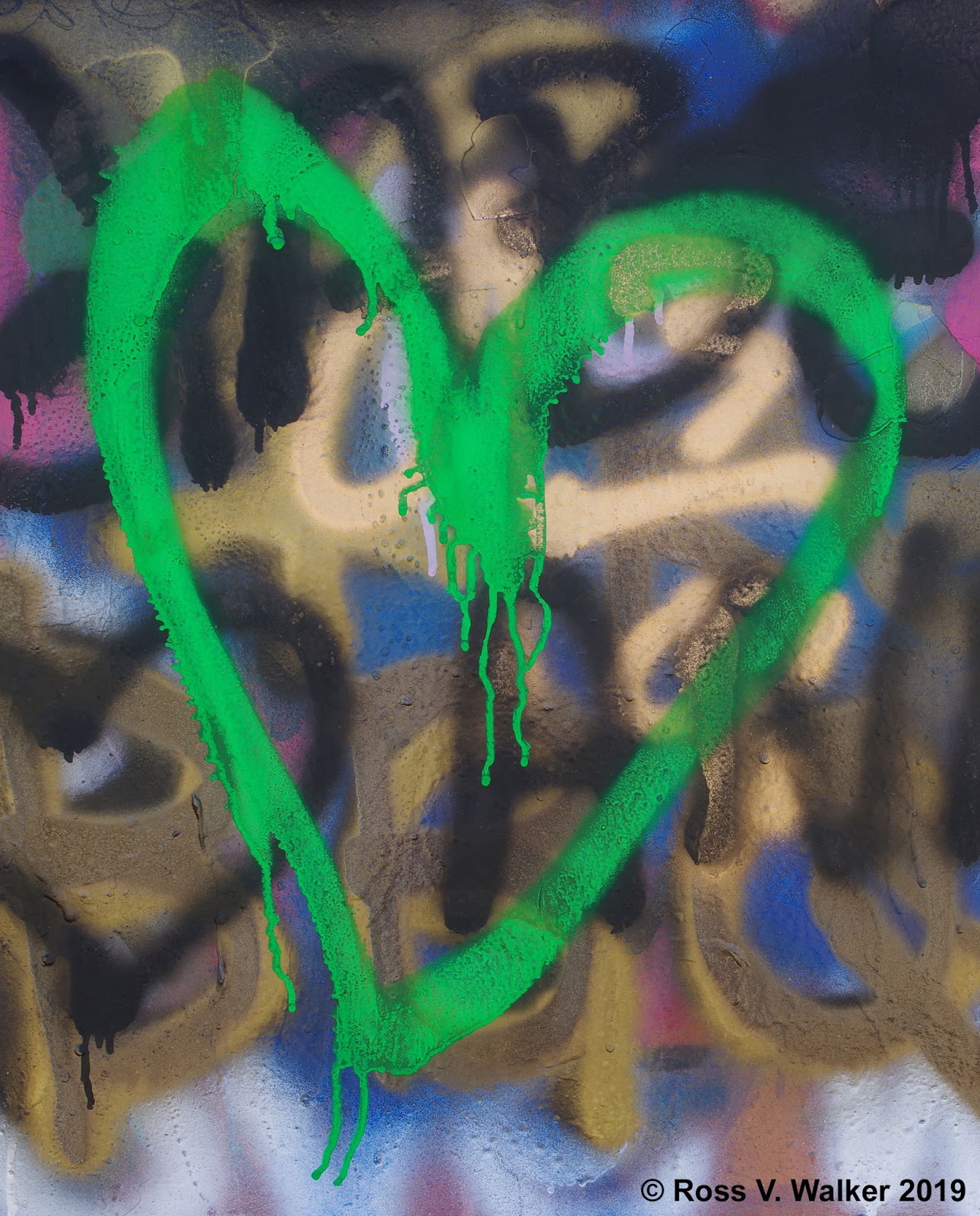
For decades the old bus sat next to highway 261 in Washtucna, Washington where it was spray painted by graffiti artists.  Over time it became a popular spot for painters and photographers as the bus’s appearance continually changed.


Eventually the bus was destined for the scrapyard when a letter was written by Lee Ann Blankenship, President of WHMCC (Washtucna Historical Museum and Community Center) to the Washington State Department of Natural Resources to explain the significance of the bus.  Eventually an agreement was made to move the bus to land donated by Blankenship Farms near the intersection of Highways 26 and 261.


The bus, well known as #ThatNWBus, has now been donated to WHMCC.  Artists and photographers enjoy adding their personal touch to the iconic bus.


The vibrant colors include everything from love notes to abstracts and political messages.  I loved photographing it but had some reservations that I was merely copying someone else’s “art”.  So, it was a challenge to use the colors and designs creatively.

I hope you enjoy the photos, but please remember they are copyrighted and must not be used without my permission.

Sunday, December 2, 2018

Comet, Montana Ghost Town


The last ghost town we visited on our summer camping trip, Comet, Montana, was one of my favorites.  Comet’s first mining claim was in 1869 by John W. Russell and the town was started in 1876.  The area was called the High Ore Mining District.

A row of old cabins greets visitors as they enter town.  There were about 300 people here until the mines started to play out and Comet was described as a ghost town in 1913.

In 1926 the Basin Montana Tunnel Company built a 200 ton concentrator which became the second largest mining venture in Montana.  Local mines went on to produce over 20 million dollars of silver, gold, lead, zinc, and copper.  The mill shown here with the bunkhouse was closed in 1941 and the equipment salvaged.

There are lots of wonderful old buildings like this boarding house.  Miners stayed here for 75 cents room and board.

There wasn’t enough left of this truck to identify it, but my guess is it was used to haul ore, based on the 16 leaf springs.  Comet is privately owned and there is one occupied house, so private property must be respected.  However, buildings can be viewed from the road.


There are still a few houses scattered across the hillside.  The town once had a school with 20 pupils, but they were outnumbered by the 22 saloons.


We had some pretty good clouds that day, and some of them worked well with the collapsing buildings.


There is usually an opportunity for interesting detail photos in places like Comet.

Comet was built on mining, so I will end with a photo of a mine headframe with a trestle connected to an ore bin. There is still a winch in a small building with a cable leading to the shaft on top of the hill.

Remember, these photos are copyrighted and should not be used for any purpose without permission, and usually a small payment, unless used for charitable or academic purposes.

Friday, August 25, 2017

Bear Lake County Fair - After Dark

The Bear Lake County Fair in Montpelier, Idaho is always a wonderful event.  There are rodeos, entertainment, food booths, animals, rides, craft displays, and of course a big photography display.  But after dark the fair really comes to life, and the lights are a great opportunity for photographers.

Carnival photos are best just after sunset so there is a little light and color in the sky.  This Ferris wheel changes color, and if you change shutter speeds you can get anything from colorful spokes of light to a blurred circle in infinite variations.  This one was ½ second exposure.

This is the same Ferris wheel from the other side, with carnival game prizes in the corner.  This one was taken after the sky got totally dark, and the shutter speed was 1.3 seconds, resulting in an entirely different pattern.  To reduce camera shake, a tripod is a necessity and a remote shutter release or self timer also helps.  If your camera has image stabilization, turn it off while using the tripod.

This photo of entertainers Dave Anderson and Thatch Elmer was taken on the outdoor stage.  The lights were bright enough to take the photo without a tripod, but in order to pick up details in the light and shadow, three photos were bracketed two stops over and under normal, and combined in the computer using Photomatix Essentials.  The software did an amazing job removing blur caused by people moving.

This food booth photo on the midway was taken with a 2.5 second exposure.  It is fun to use these long exposures to blur moving people.  Everyone becomes anonymous using longer exposures.


Longer exposures can also be used to make abstract images.  This giant swing was exposed for 0.8 seconds, but as the dangling swings were being lowered I increased the exposure to 2.5 seconds to create the abstract image.

So, look for bright colors, movement, and lights to get unusual photos at the county fair.


Please note that my photos are copyrighted and must not be used without permission, and usually a small fee.

Friday, July 14, 2017

Painted Hills, Oregon

John Day Fossil Beds National Monument has three separate units.  One of these, the Painted Hills, near Mitchell, Oregon, is famous for its amazing hills striped with color.  It was the highlight of my 47 th camping trip in 36 years with Bruce Gregory and Stephen Johnson.
During the day the colors can appear fairly muted, but as the sun gets low the stripes become brighter, as in this photo from the overlook trail.


The wonderful stripes and contours are perfect for landscape abstracts with a long lens.  These two photos from the overlook trail show how the colors can change with the time of day.  The colors often become golden just before sunset.


Another beautiful location is the perfectly formed Red Hill, where we also found prairie clover.


The soil here is very delicate and would be damaged by walking on it, so most areas are fenced off.  In the Painted Cove area a boardwalk allows visitors to see the textures and shapes close up.

And finally, here is a five shot panorama taken from the overlook trail just as afternoon shadows start to touch the hills.

I hope you enjoy these photos, but please remember that they are copyrighted and must not be used without permission, and usually payment of a small fee.

Friday, July 15, 2016

Steptoe Butte Revisited

I visited Steptoe Butte in 2013 on my annual camping trip with Bruce Gregory and Steve Johnson, and liked it enough to revisit with my wife, Linda, this May.  This post is about 6 weeks late because I’ve been on another annual camping trip.  Having fun gets in the way of timely posts.


The view from Steptoe Butte varies from month to month as new crops are planted and others are harvested.  On this visit, we saw patterns created by combinations of bare ground and growing crops.  The air was quite hazy, so these photos have been processed to increase clarity and contrast.


We stayed fairly late, so we were treated to some great sidelight touching beautiful farms nestled in green valleys.


The Palouse region of Washington is a remarkable area of gently rolling farmland.  We enjoyed photographing it from below (see previous posts) and Steptoe Butte gave us an entirely different view from above.  Large curvy fields became wonderful abstracts when viewed from here.


Since we were shooting across the tops of the fields, the best abstracts were usually fairly narrow, so I have cropped them.  But this image had two complementary abstracts that I think look pretty good together.


Sometimes I wonder if the farmers arrange their fields just for the benefit of photographers.  The view of these curvy fields from Steptoe Butte is just phenomenal, and we thoroughly enjoyed our visit to the Palouse.

However, I did have one complaint.  Steptoe Butte is a state park, and whoever is in charge of this place should be ashamed of the poor condition of the park.  We were there on the Memorial Day weekend, so it was crowded, and the garbage cans were overflowing and the restrooms unusable.  There are potholes big enough to swallow a Toyota.  Come on, Washington, you can do better than that.

Please note that my photos are copyrighted and must not be used without my permission.