Showing posts with label cabin. Show all posts

Sunday, December 2, 2018

Comet, Montana Ghost Town


The last ghost town we visited on our summer camping trip, Comet, Montana, was one of my favorites.  Comet’s first mining claim was in 1869 by John W. Russell and the town was started in 1876.  The area was called the High Ore Mining District.

A row of old cabins greets visitors as they enter town.  There were about 300 people here until the mines started to play out and Comet was described as a ghost town in 1913.

In 1926 the Basin Montana Tunnel Company built a 200 ton concentrator which became the second largest mining venture in Montana.  Local mines went on to produce over 20 million dollars of silver, gold, lead, zinc, and copper.  The mill shown here with the bunkhouse was closed in 1941 and the equipment salvaged.

There are lots of wonderful old buildings like this boarding house.  Miners stayed here for 75 cents room and board.

There wasn’t enough left of this truck to identify it, but my guess is it was used to haul ore, based on the 16 leaf springs.  Comet is privately owned and there is one occupied house, so private property must be respected.  However, buildings can be viewed from the road.


There are still a few houses scattered across the hillside.  The town once had a school with 20 pupils, but they were outnumbered by the 22 saloons.


We had some pretty good clouds that day, and some of them worked well with the collapsing buildings.


There is usually an opportunity for interesting detail photos in places like Comet.

Comet was built on mining, so I will end with a photo of a mine headframe with a trestle connected to an ore bin. There is still a winch in a small building with a cable leading to the shaft on top of the hill.

Remember, these photos are copyrighted and should not be used for any purpose without permission, and usually a small payment, unless used for charitable or academic purposes.

Tuesday, October 2, 2018

Elkhorn, Montana Ghost Town


I am still trying to catch up on reviewing photos from our annual camping trip to Montana.  So, here are photos of Elkhorn, Montana, one of five ghost towns we visited in July.

 This silver mining town was established in 1872 and had a peak population of about 2500.  Now the population is 10, but I’ll bet most of them are part time residents.

The big attraction for ghost town hunters is Gillian Hall (left) and the Fraternity Hall (right).  These buildings are now preserved as Montana’s smallest state park.

The National Register of Historic Places states that the Fraternity Hall (built in 1893) is perhaps the most photographed ghost town building in the United States and lists it as number 1 of 12 western structures that should be saved.  This room was used for dances, meetings, and theatrical shows.

Elkhorn is a mix of abandoned and restored buildings.


The beautiful cemetery is on a quiet isolated hillside.  A large number of children were buried there after a diphtheria epidemic in 1888 - 1889.


Mining relics and ruins are scattered around, but most are in areas posted “no trespassing”.  The mines opened and closed several times and were finally closed for good in 1937 after producing about $14 million of silver.  Except for the two Halls, most of the town is private property but can be photographed from the road.


Please be aware that these photos are copyrighted.  If you would like to use them for any reason, please contact me.  My fees are very reasonable, and often free for charitable purposes.

Wednesday, June 20, 2018

The Shane Cabin


Linda and I stayed in Jackson Hole, Wyoming for two nights so we could explore Grand Teton National Park.  After seeing most of the popular sights we left the crowds and drove to the Gros Ventre River Road.  Here we found a cluster of three log buildings popularly known as the Shane cabin.

This is an old homestead with a remarkable history in popular culture.  It started In 1916 when Luther Taylor homesteaded here.


Extra care was made to make the cabin comfortable.  The inside of each log was flattened, insulated with newspapers, whitewashed and covered with layers of decorative wallpaper.  The marks of the ax or adze can still be seen, but the paper covering is gone.  Through a window we could see one of the outbuildings.


In 1948 the property was sold to rancher Andy Chambers and his son Roy, who rented the cabin out for a couple of years.  The cabin had been vacant for a while when it was used in the 1953 movie "Shane" and has been abandoned since then.  The black and white photo shows the other remaining outbuilding.


This beautiful view of the Grand Tetons was probably one reason the cabin was selected for the iconic western movie, thought by many to be one of the best ever.

Now the cabin is returning to the earth.  The roof and floor are gone, and the cabin’s floor joists balance on a few remaining foundation rocks.  No one has tried to preserve the site and there isn’t even a sign to describe its wonderful history as a homestead and then a movie star.

Please be aware that these photos are copyrighted.  They must not be used without my permission.

Friday, October 27, 2017

Monarch Mine, Nevada

After leaving Sprucemont, Nevada (see the previous post), we continued up Spruce Mountain about two more miles.  The road got much rougher, although it was not nearly as difficult as we expected.  I did use four-wheel drive, and in one or two places low range, and was glad I recently added skid plates to my truck.

Our first view of the mine area included a few houses along a side road.  The area is very steep, with houses on different levels of the hillside.

Most of the buildings are frame houses, but there is one cabin made from massive logs that probably dates back to the earliest days of the mine, around 1899.

This is a true ghost town.  Many buildings are totally collapsed, and those that are still standing have a lot of damage.  Some look like they were nice at one time, but now the wallpaper is peeling and the ceilings coming down.  But, their positions high on the mountains had great views from the windows.


There is a huge crumbling ore bin right in the middle of the residences, and a mine shaft nearby, so miners didn’t have to go far to work.  The gigantic timbers were held together with massive nuts, bolts, and square washers.  Now many are gone, and others are beautifully rusty.

The Monarch Mine was a big producer of lead during World War I.  According to the USGS website, 

"About $200,000 worth up to 1902; 21,000 tons ore worth $475,000 from 1919 to 1921; more production through 1952. Total production was over $1,000,000 worth, including some zinc and copper."

This photo gives some idea of how steep the mountain is, and how houses were built on plots leveled out of the hillside.  We enjoyed exploring the townsite, but didn’t stay long because snow flurries started, and we were a long way from pavement.  The Spruce Mountain mining area was well worth the visit.

I hope you enjoy the photos, but please respect the copyrights and do not use them for any purpose without permission.

Monday, October 24, 2016

Humboldt City, Nevada

About 500 people lived here once, but Humboldt City has been a ghost town since the post office was removed in 1869.  Silver was discovered here in 1860, and the city was built here to support several mines.  But, it didn’t last long.
A dirt road runs from the valley through the center of town.
Humboldt City is located along a creek that runs through a canyon high on a mountain in the Humboldt Range of Nevada.  There were 200 buildings here, and now you can still find many rock ruins scattered through the underbrush and on the hillsides.
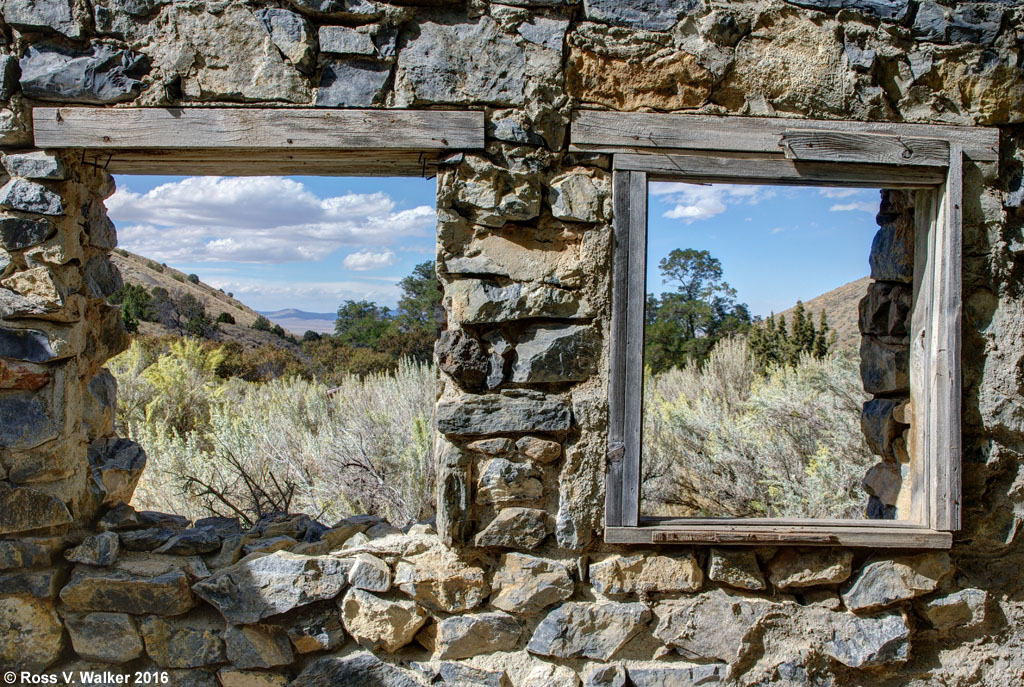
Some of them, like this one with the double windows, have signs that people tried to move in here long after the city was abandoned.  We found a cinder block fireplace added to this old rock wall.
This cabin also has some modern materials like rusty window screens.  It was hard to get to because it was built in a deep gully next to the creek.  I don’t understand why it wasn’t washed away years ago.
There were two hotels here; the Coulter House and the Iowa House.  I’m guessing that this ruin was one of them because of the large front room and a smaller room in back that could have been a kitchen.
The view from the hotel looked up the canyon toward the mountains where the mines were located.  It looks like it has been a long time since the last “No Vacancy” sign went up.

Humboldt City is just a couple of miles from busy Highway 80, near Mill City, Nevada, but being there is like being in a different world.

Remember, all my photos are copyrighted.  Please do not use them for any purpose without permission.

Tuesday, January 20, 2015

Chesterfield In Winter

Chesterfield, Idaho is an agricultural ghost town in the southeastern part of the state.  It was founded in 1880 by Mormon pioneers.  It was a hard place to make a living, and gradually became a ghost town due to drought, harsh winters, and the depression.
Today, Chesterfield is undergoing a revival of sorts as descendants of the early families are restoring the town.  The Chesterfield Foundation recently purchased the beautiful Muir-Butterfield house, and has started restoration by rebuilding the porch.
The LDS Meeting House is probably the best preserved building in town.  When I first started visiting Chesterfield it was a museum, but now it has been restored back to its original form.  In summer, many of the buildings are open for visitors and tours.

In winter, the town is boarded up, deserted, and resting quietly in the snow and cold.  Linda and I visited with three other members of our Sharp Shooters Camera Club.

There is a lot to see and photograph in the quiet of winter.  A restored tractor is parked near the shadow of rusty farm equipment, and interesting details are everywhere.


Old equipment, frosty fences, interesting buildings, ancient gas pumps, snowdrifts – the photo opportunities are wonderful.

The buildings include log cabins, stately brick homes, religious structures, and stores.


A windmill stands alone on a hilltop.


There are 41 buildings in the historic district, and most near the center of town have been restored, but many around the outskirts of town still are in “ghost town” condition, so there is a nice mix of photography subjects.  If you want to see the interiors and talk to knowledgeable people about the town, visit between Memorial Day and Labor Day.  But if you want to see Chesterfield when it is deserted and quiet, visit in the winter.

Please note that all of my photos are copyrighted and must not be used without my permission.

Sunday, February 27, 2011

The winter of 2011

The east has gotten all the publicity for their big winter storms this year, but the west has also had a lot of snow.  So far, no really big storms, but a steady accumulation has made life interesting.  We got 33 inches of snow in February in a series of storms that blasted the Bear Lake Valley.
We went to the historic downtown area of Montpelier during a break in the daily snowstorm. Snow must be plowed to the middle of the street where it is stacked until it can be hauled away.


Of course you need to dig out your car before your trip downtown.

We drove north about five miles where the beauty and history of the valley appeared in Bennington, at the Mose Wright cabin.  Imagine raising 12 children in this tiny cabin in snowy conditions like this?  Mose Wright was my wife's great grandfather, a Pony Express rider, and Idaho state legislator.