The Bighorn Medicine Wheel is a geoglyph in northern Wyoming. That is, it is a pattern laid out in stones on the ground. This Medicine Wheel has been used for Native American rituals since its construction anywhere from 500 to 1500 years ago. Access to the Medicine Wheel is limited to a few summer months because of its remote location and 9642' elevation.
The trail to the Medicine Wheel is about three miles round trip, and nearly every step is uphill or downhill. At this high elevation it can be a difficult walk for some people, but the high mountain scenery is spectacular. People who have difficulty walking can drive to the site if they can figure out how to get past the log gate. I walked, but had to leave Linda back at the parking lot.
The Medicine Wheel is 80' in diameter and has 28 spokes. The four outer cairns align with the rising and setting sun during the summer solstice. Perhaps the spokes represent the 28 days of the lunar month. The Medicine Wheel appears to be part of an enormous network of regional prehistoric sites dating back 7000 years! Note that this photo was altered in Photoshop to remove a rest room and two cars from behind the back fence.
Prayer offerings are still being left on the rope fence all the way around the Medicine Wheel. After I hiked back to the parking lot I managed to open the gate and drive Linda to the site so that she was able to see it. And, I got to see it twice.
Montana State University picked up two of these photos and used them in their magazine, "Confluence". You can see the article and photos on page 11 here: http://issuu.com/montanastateuniversity/docs/confluence2011
Photography discussion and photos by Ross Walker. There are photos from various shoots, and I plan to discuss photography tips and activities from our Sharp Shooters Camera Club. More of my photos are available at www.hisandhersphoto.com
Monday, September 19, 2011
Tuesday, September 13, 2011
Gebo, Wyoming ghost town
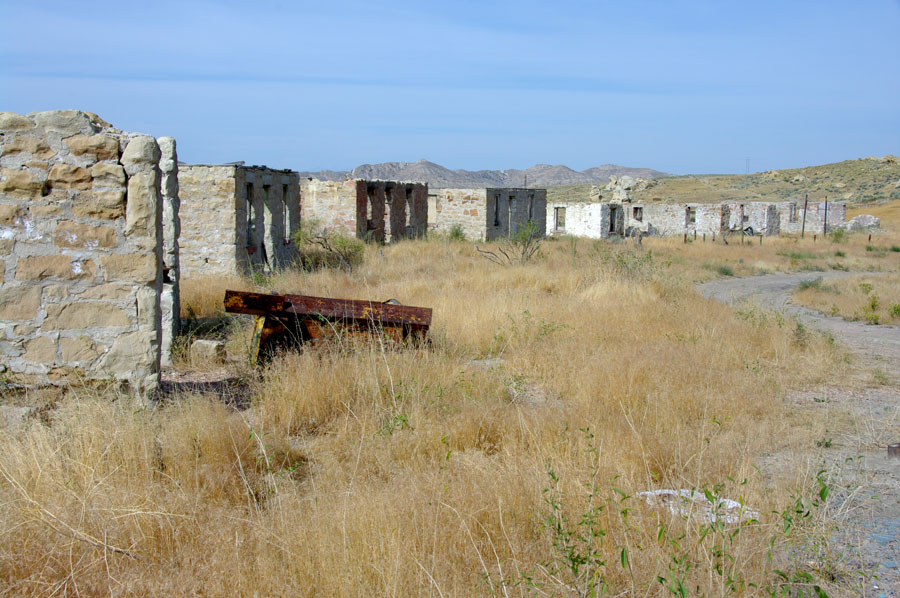
Gebo, Wyoming is an isolated ghost town near Worland. It was a coal mining town from 1906 until 1938.
There are seven ruined stone buildings curving along the top of a ridge. They might have been nice at one time since they still have remnants of concrete sidewalks, gates, brick windowsills, and other comforts.
The town had 1200 residents in 1929 and buildings were scattered over the desolate countryside. BLM leveled most of the town in 1971. So, why did these buildings survive?
Maybe these stone ruins were on private land so BLM had to leave them standing.
Vandalism and the passage of years have not been kind to Gebo. The town is used for target practice now.
There are seven ruined stone buildings curving along the top of a ridge. They might have been nice at one time since they still have remnants of concrete sidewalks, gates, brick windowsills, and other comforts.
The town had 1200 residents in 1929 and buildings were scattered over the desolate countryside. BLM leveled most of the town in 1971. So, why did these buildings survive?
Maybe these stone ruins were on private land so BLM had to leave them standing.
Vandalism and the passage of years have not been kind to Gebo. The town is used for target practice now.
Labels:
Gebo,
ghost town,
Wyoming
Location:
Gebo, WY 82443, USA
Monday, August 22, 2011
EBR-1 Atomic Museum
The first power plant in the world to produce useable electricity from atomic energy is located near Arco, Idaho.
Before I continue with photos of the plant...
This object was photographed next to the parking lot. Can you figure out what it is? The answer is at the end of this post.
Experimental Breeder Reactor - 1 first produced electricity on December 20, 1951 and was decommissioned in 1964.
The control room looks like a 50's science fiction movie with dials, toggle switches, and paper graphs. No computers here.
Scientists were ready for all emergencies.
PHOTO TIP:
EBR-1 has a dark interior with different kinds of lighting. Many of these photos were taken at ISO 3200, and white balance had to be changed for some rooms.
Where else can you stand on the core of a nuclear reactor? Fuel rods used to be lowered into this hole which is now covered by plexiglass.
EBR-1 was fueled with U-235 and created plutonium. It was a "breeder" reactor which produced more fuel than it consumed!
The first bulbs ever lit by atomic energy were right here! This circuit is the original, but the bulbs have been replaced.
WHAT WAS THE MYSTERY OBJECT?
It was a HTRE-3 prototype atomic jet engine mounted on a test stand. This monster engine actually worked in a test, but was never placed in the X-6 bomber designed for it. No one ever figured out how to avoid frying the airplane crew while keeping the weight of the engine down, and the program was scrapped by President Kennedy.
Before I continue with photos of the plant...
This object was photographed next to the parking lot. Can you figure out what it is? The answer is at the end of this post.
Experimental Breeder Reactor - 1 first produced electricity on December 20, 1951 and was decommissioned in 1964.
The control room looks like a 50's science fiction movie with dials, toggle switches, and paper graphs. No computers here.
Scientists were ready for all emergencies.
PHOTO TIP:
EBR-1 has a dark interior with different kinds of lighting. Many of these photos were taken at ISO 3200, and white balance had to be changed for some rooms.
Where else can you stand on the core of a nuclear reactor? Fuel rods used to be lowered into this hole which is now covered by plexiglass.
EBR-1 was fueled with U-235 and created plutonium. It was a "breeder" reactor which produced more fuel than it consumed!
The first bulbs ever lit by atomic energy were right here! This circuit is the original, but the bulbs have been replaced.
WHAT WAS THE MYSTERY OBJECT?
It was a HTRE-3 prototype atomic jet engine mounted on a test stand. This monster engine actually worked in a test, but was never placed in the X-6 bomber designed for it. No one ever figured out how to avoid frying the airplane crew while keeping the weight of the engine down, and the program was scrapped by President Kennedy.
Labels:
Atomic City,
EBR-1,
Idaho,
nuclear,
reactor
Location:
7th Ave W, Blackfoot, ID 83221, USA
Friday, July 22, 2011
Thunder Mountain, Nevada
Thunder Mountain... the name sounds like some high Sierra location in the wilderness, but it is much more difficult to descibe.
Thunder Mountain Indian Monument is a State of Nevada historic site. Bizarre, artistic, eclectic, artsy, and even kind of scary, Thunder Mountain is a collection of faces, towers, junk, statues, old cars, and buildings made from concrete, bottles, windshields, typewriters, and whatever other building materials the artist could find.
The creator of the monument was Frank Van Zant who later in life called himself Chief Rolling Mountain Thunder. He described his creation as a monument to the American Indian. During his life he was a World War II veteran, assistant pastor, sheriff's deputy, and private investigator, but inspired by a bottle house he had seen in the desert, he moved his family to rural Imlay, Nevada and created his unusual home.
A bottle wall seen from the inside.
Nightmarish faces, deteriorated by years of exposure, are found everywhere you look, peering out from corners or towers, and a Madonna seems to watch you from behind a wire fence. Native American symbolism is everywhere, but other symbols are harder to understand, like an amazing human / butterfly. The site is deteriorating, but the artist's son is trying to preserve and restore it. There is a caretaker on the site, and he gladly let us inside the fence to take photos. There is no charge, but donations are accepted and welcome.
Labels:
Nevada,
Thunder Mountain
Location:
Thunder Mountain, Nevada 89418, USA
Wednesday, July 13, 2011
Rent a locomotive!
One of the highlights of this year's annual camping trip was renting a locomotive for an hour at the Western Pacific Railroad Museum in Portola, California.
The 917-D was built around 1951 or 1952 and has a 16 cylinder engine. Visitors can rent this engine or a smaller switch engine and run it around a relatively short section of track.

The 917-D was built around 1951 or 1952 and has a 16 cylinder engine. Visitors can rent this engine or a smaller switch engine and run it around a relatively short section of track.
Ross Walker ran the locomotive under the watchful eye of Charlie, a museum docent. Photo by Bruce Gregory.
Stephen Johnson was the second engineer.
Bruce Gregory got the next turn.
The victorious engineers as photographed by Charlie the museum docent.
Labels:
California,
locomotive,
museum,
Pacific,
Portola,
train,
Western
Location:
Portola, CA 96122, USA
Friday, July 8, 2011
Forest City, California - Almost a ghost town
Day 3 of our 30th annual camping trip brought us to one of our favorite photography subjects, a ghost town. This trip typically takes us to places that most people don't go. We don't look for in-your-face gorgeous well-known places, but rather we go to historic out-of-the-way places that we find personally interesting. Today it was a semi-ghost town in the northern Sierra foothills called Forest City. Some of the buildings here are used as summer homes, but the place is largely deserted.
The first thing you see as you enter Forest City from the dirt road is a cemetery. Many graves here date from the 1880's.
The old dance hall is now an informal museum, open by donation if you can find someone to unlock the door. The sagging building looks extremely unstable but is still used for community events.
The interior has an eclectic mix of historic items and dusty modern stuff. It looks like an attempt has been made to shore up the shaky building with a cable stretched across this window.
An uphill climb reveals a wonderful old school building hidden in the trees. The few people we saw here were friendly and helpful when we showed an interest in their historic town.
The first thing you see as you enter Forest City from the dirt road is a cemetery. Many graves here date from the 1880's.
The old dance hall is now an informal museum, open by donation if you can find someone to unlock the door. The sagging building looks extremely unstable but is still used for community events.
The interior has an eclectic mix of historic items and dusty modern stuff. It looks like an attempt has been made to shore up the shaky building with a cable stretched across this window.
An uphill climb reveals a wonderful old school building hidden in the trees. The few people we saw here were friendly and helpful when we showed an interest in their historic town.
Labels:
California,
Forest City,
ghost town
Location:
Forest, CA 95910, USA
Wednesday, July 6, 2011
30th Annual Camping Trip
I have been camping for 30 years in a row with the same guys; sometimes twice a year. This has been called the "desert trip" even though we have camped in California, Idaho, Nevada, Utah, Wyoming, Montana, and Oregon. Check out the story of the "Desert Rats" here:
http://www.hisandhersphoto.com/friends/hhdrats.htm
This year we are camping in the northern Sierra in California. This was the first day of exploration and we included Donner Summit, Yuba Gap, Emigrant Gap, and more.
We heard rumors of indian grinding rocks in a remote location near Yuba Gap. It was difficult to get to, but we did find the grinding rocks. However, the main attraction for me was the surrounding area. There were a number of natural patterns like this huge snag behind a lichen spotted rock.
Another snag had been there awhile and formed a death pattern on the granite.

An un-named marshy pond added color and patterns to the scene.

Reflections of a dead tree made a great subject in the marsh.

I will try to add more photos as the trip continues.
http://www.hisandhersphoto.com/friends/hhdrats.htm
This year we are camping in the northern Sierra in California. This was the first day of exploration and we included Donner Summit, Yuba Gap, Emigrant Gap, and more.
We heard rumors of indian grinding rocks in a remote location near Yuba Gap. It was difficult to get to, but we did find the grinding rocks. However, the main attraction for me was the surrounding area. There were a number of natural patterns like this huge snag behind a lichen spotted rock.
Another snag had been there awhile and formed a death pattern on the granite.

An un-named marshy pond added color and patterns to the scene.

Reflections of a dead tree made a great subject in the marsh.

I will try to add more photos as the trip continues.
Subscribe to:
Posts (Atom)