Showing posts with label wildlife. Show all posts

Thursday, April 26, 2018

Trumpeter Swans Nesting

I haven’t been able to get out much lately, so this is my first post in a long time.  I went with Bruce Grayum to Bear Lake National Wildlife Refuge and saw quite a bit of wildlife, including a few trumpeter swans.  They are the world’s largest waterfowl, and were very rare here just a few years ago.  Now there are several nesting pairs in the refuge, and they can be seen in several places in the valley.

There was one pair preparing to nest on an island in the biggest pond along the auto tour route.  We could see the female dragging reeds into a pile for the nest.

Soon she left the nest and swam out to the male, then both took off and flew close to where we were watching.  Because of there size, trumpeter swans need a long runway for takeoff.

The two swam together, often bobbing their heads, which is flirtatious behavior in the swan world.

They were beautiful to watch swimming together and I hope we will be able to see baby swans soon.

Thank you for viewing these photos.  Please do not use them for any reason without my permission.

Saturday, April 1, 2017

Garter Snakes Mating

Our huge snow pack in the Bear Lake Valley melted fast.  While there is still snow in the mountains, here on the valley floor we are dealing with a lot of water, and the smaller members of our wildlife community are appearing.
I was driving around the valley looking for photos of the flooded fields when I spotted these two intertwined common garter snakes (Thamnophis sirtalis) that had probably just emerged from hibernation.
I assumed they were mating, but after reading about them it is possible they were huddled together for warmth in our cold climate.  Some males are able to produce female pheromones which attract other males away from the den.  Then the first male ditches the pheromones and races back to the den where he hopes to have the females to himself.  This same technique tricks other males into “warming up” the trickster.
These snakes were very patient with me.  When I got down to their level, the smaller one stretched out toward the lens curiously, and I wonder if he was looking at his reflection.  Also, I wonder about the dusty color of these usually brilliant snakes.  Could it be that after emerging from hibernation their colors are dull until after they molt?  I just don’t know.

Please respect my copyright and do not use these photos without permission.

Sunday, March 19, 2017

Feeding An Elk Herd

This winter has been the most difficult one I’ve seen in the Bear Lake Valley since we moved here in 1999.  So far, snowfall has been over 10 feet and we are sure to get more.  Of course, it was more compact on the ground so it was just a few feet deep, but when combined with thick layers of ice it has been very difficult for wildlife to find food.  There are places where people feed deer and elk every year in this area, but this year new feeding stations have been set up to take care of animals that normally make it through winter on their own.

Micah Rigby and R C Hymas on their three-horse sleigh.

In Bear Lake County alone, 20 emergency feed grounds have been set up for deer, and 4 for elk.  I was fortunate to be able to ride along on a horse-drawn sleigh with fellow photographer Jim Parker to feed a herd of elk at Banks Valley, Idaho.  The public was asked to stay away to avoid stressing the animals.

Even the horses seemed interested in the elk herd.

A work sleigh with three horses was driven a couple of miles by R C Hymas and Micah Rigby for the cross country trip to where a herd of about 400 elk was waiting.  The elk have become accustomed to sleighs at the annual feed grounds, but here the elk were wild, and they kept their distance.  As the sleigh was driven along the line of elk, sections of hay were kicked off from four big bales so they would be strung out enough for all the elk to get to some.  They lined up like kids in a school lunch line to be fed.

These animals were easily spooked and if one started to run, several would go along, but they wouldn’t go too far as long as they had hay to eat.

I admire the way these guys handled their horses.  The jobs of harnessing and driving these beautiful animals were second nature to them, and I appreciate all they are doing to help Idaho’s wildlife.

Jim Parker holds the tired horses while they are unhitched from the sleigh.

Please be aware that my photos are copyrighted and must not be used without permission.  I often donate usage for charitable or educational purposes, but require a small fee for personal use.

Monday, January 30, 2017

Mule Deer Migration

This winter is the harshest one I’ve seen since I moved to the Bear Lake Valley, Idaho seventeen years ago.  Winter is half over and we have already had over 100 inches of snowfall.  Of course it has been compressed on the ground quite a bit, but there is still so much snow that deer are unable to forage in many areas.  The east side of Bear Lake usually has less snow than the rest of the valley, so mule deer are migrating there in amazing numbers.
There are lots of shrubs in the area; sagebrush, rabbitbrush, and more.  Mule deer are browsers, and can live off these plants that grow above the deep snow.  They look pretty good so far, but there are so many that I’m afraid the food will be gone soon.
Almost all the deer we see are does and fawns.  This fawn is browsing on sagebrush.  The bucks are more cautious and have been staying back in the hills, but a few are showing up now.  Since they took longer to get to the food at the lake, they look skinnier than the does.
It is a lot of fun to drive to Bear Lake and see these beautiful animals.  Usually, deer run away from cars here, but these hungry animals have become bolder, and will often stay close enough for photos.
The deer are up to their bellies in snow in many places, so feeding stations have been set up for deer and elk in areas with the deepest snow.  I hope the Bear Lake deer won’t need to find their way to one of those stations to survive this difficult winter.

Please respect the copyright on my photos, and do not use them without my permission. 

Monday, May 2, 2016

Canada Goose Goslings

Spring has finally come to the Bear Lake Valley in Idaho.  There still aren't many leaves on the trees since we live at nearly 6000' elevation, but the Canada Geese have been here for awhile, and now their babies are starting to appear.  Linda and I drove out to Bear Lake National Wildlife Refuge today, and while we saw hundreds of adult pairs, we only saw three with goslings.
It might be awhile before we see more goose families.  The parents are very protective of their babies and swim with them in a tight group.  After a minute or so, they swam into the bulrushes and the babies nearly disappeared as they blended in to the surroundings.
Who can resist these little balls of yellow fluff?  They will stay with their parents for up to a year.

161 bird species have been counted here at Bear Lake National Wildlife Refuge.  Hay fields in the area are cut to provide feeding sites for the birds, and alfalfa, wheat, and barley are grown around the edge of the marsh to provide food for wildlife.  We are lucky to have this resource so close to home.

Please note that my photos are copyrighted and should not be used without permission.

Sunday, April 3, 2016

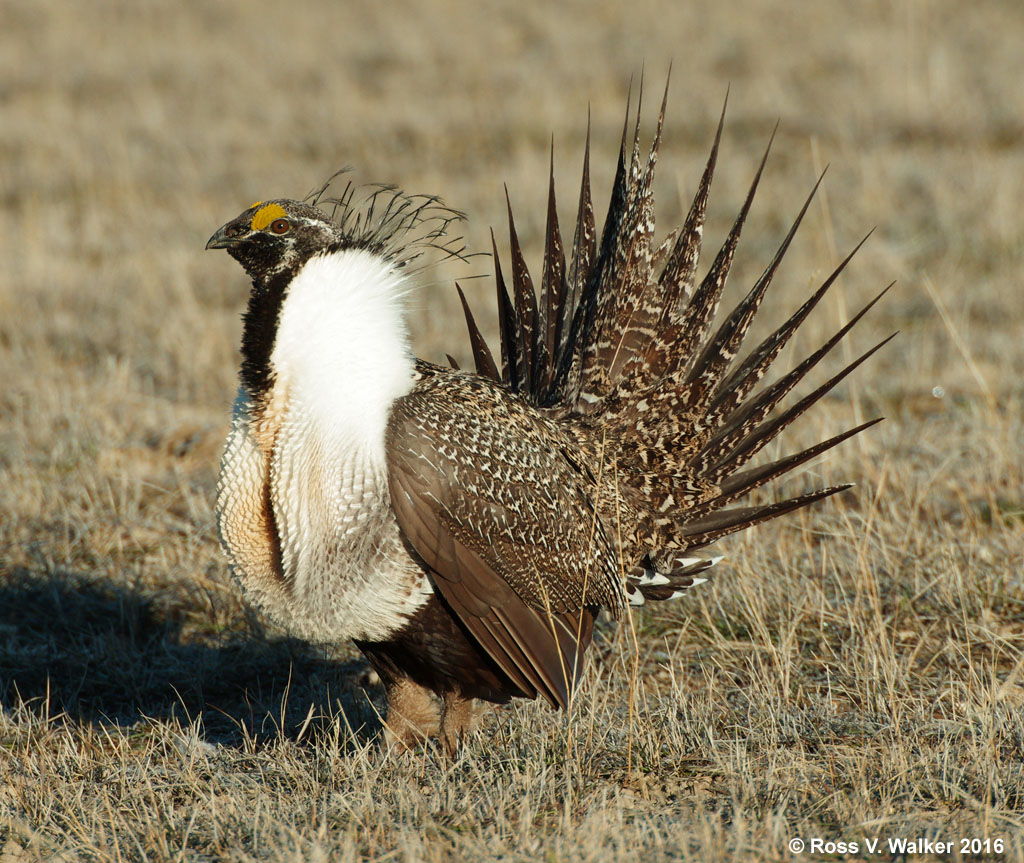
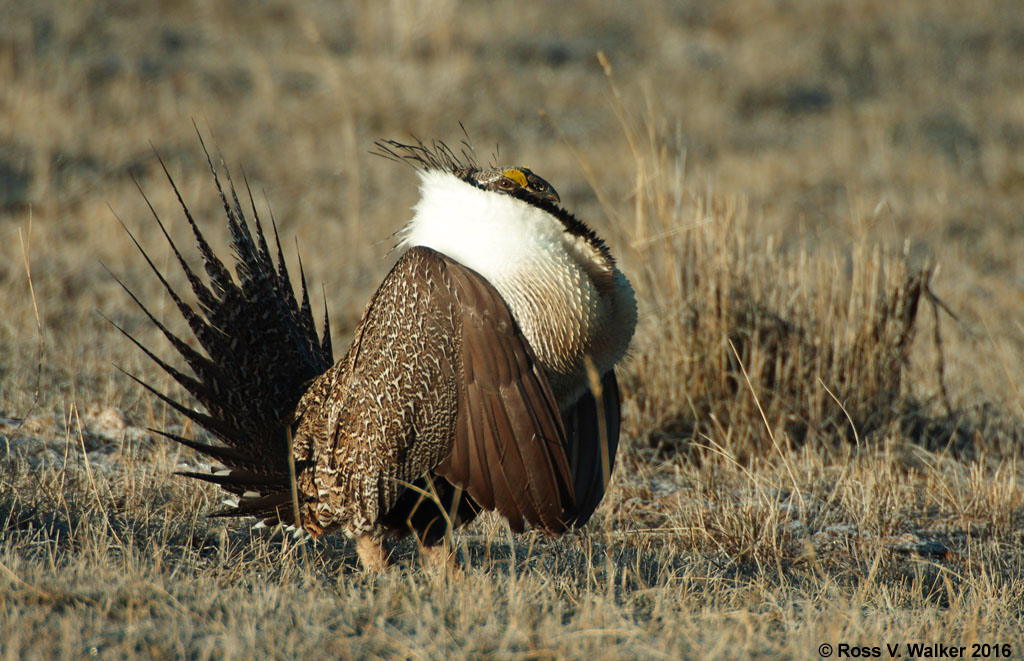
Greater Sage-Grouse

Jim Parker has been responsible for some of my best adventures in the Bear Lake Valley, Idaho area, and this one is near the top of my list.  Every spring the greater sage-grouse gather together and put on a courtship display in areas called leks.  These are relatively clear areas in the sagebrush where groups of males can do their best to attract the females.  The lek locations are not publicized to avoid conflicts with people.
Jim is really good at tracking down interesting things to photograph.  He picked me up at 6:15 AM and we drove to an area where he had seen grouse the previous day.  It was well before sunrise when we got there, and there were no grouse.  An hour or so later, the sun came up and we saw a few in the distance.  They were easy to see because of their bright white collars.  Jim put his truck in 4wd to drive across country where we found a lek with dozens of male sage-grouse.
The males put on a wonderful display, fanning their tails, strutting, and inflating air sacs in their chests.  Sometimes their heads almost disappeared into their feathers because the air sacs were so big.  They deflate these sacs with an audible POP, which I suppose is meant to be irresistible to the hens.
We were very close to the action, but most of the males didn’t seem to care and continued with their displays, but the females kept their distance.  After a half hour of watching and taking pictures we left, and we hope that the cautious hens came to the lek in response to these remarkable displays.  Just one or two dominant males will mate with all the females, so presenting an impressive display is really important.
The greater sage-grouse was considered for placement on the endangered species list, but that would have had a big impact on ranching, oil and gas exploration, etc.  An effort to improve sagebrush habitat had a positive impact on sage-grouse survival and avoided placement on the list, at least for now.

Please note that my photos are copyrighted and must not be used without my permission.